
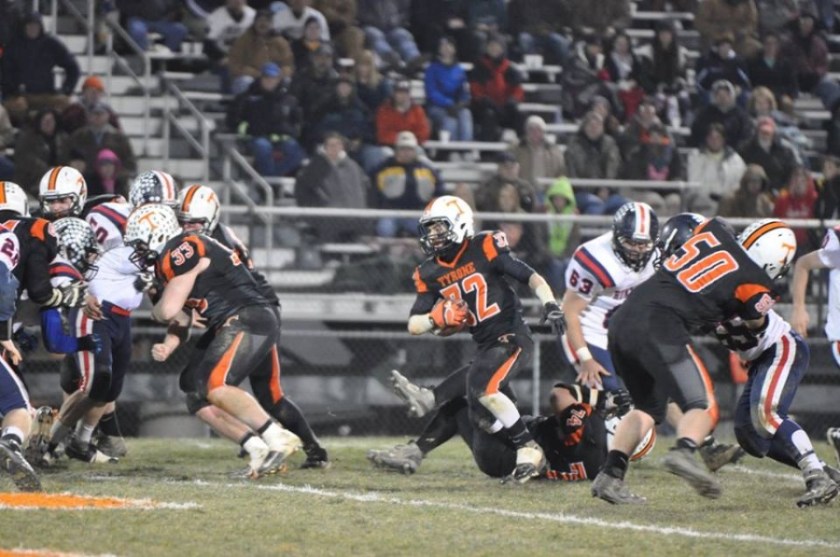
Many Tyrone backs shined brightly, if only for a season
The Police had a big year in 1983.
Already a hugely successful band by any measure, the British trio in that year released its final studio album Synchronicity, and it was a smash hit, producing three songs that landed in the top 3 on Billboard and another in the top 20, including the No. 1 song of 1983, “Every Breath You Take.”
Iconic vocalist Sting emerged just a few short years later as a solo star, and he alone went on to sell almost 80 million records.
Twelve spots down on the Billboard Top 100 in 1983 is a song that has come to hold as big a space in the 80s musical zeitgeist as anything the Police ever released, an instant classic by Dexys Midnight Runners called “Come on Eileen.”
Dexys Midnight Runners – now known only as Dexys – had a brief run at popular success in the UK during the 80s and continue to make music to this day, with their last album dropping as recently as 2023, but nothing ever hit quite like “Come on Eileen.” The fledgling cable television network MTV wasn’t two years old when the song was released in the states, and looking to fill air time it turned to British groups like Dexys Midnight Runners, helping to spark the Second British Invasion. That gave the group enormous coverage and air play, but try as they might they never achieved the same level of acclaim and recognition again.
The point is, it’s not easy to rise as high as Dexys Midnight Runners made it in 1983, and they’re far from the only band to briefly burn brightly only for the light of their fame to be snuffed out as quickly as it was ignited. For every Four Tops there’s a Sam the Sham and the Pharaohs. For every Michael Jackson there’s a hundred Rockwells.
Such artists have come to be known as one-hit-wonders, and that’s a term that can easily be recognized to have negative connotations.
Popular music isn’t the only realm where you’ll find people who’s success was sizeable but short-lived. After all, just reaching a high level of achievement at anything is difficult enough. Staying there? That’s a whole other ball game.
In that way, it’s more fitting to look at these achievers not as people who went from boom to bust but as supernovas – celestial objects that were once brilliant stars. Unable to sustain their glory they go out in spectacular fashion, shining brighter than anything else in the galaxy.
Tyrone’s football program has had its share of supernovas. Often, high school football stardom is all about timing: play two years earlier and there are two seniors ahead of you on the depth chart who can get the job done just as well. If everything is going right within a program, kids are going to have to wait their turn.
It’s what those players do when their number is called that makes all the difference and serves as the dividing line between a supernova and someone who merely got on the field.
Where running backs are concerned, there are quite a few players who had just one season as the Golden Eagles’ featured back but still managed to run their name into the record books. Some of them spent the early part of their careers waiting in line behind all-time greats. Others were thrust into prominent roles due to injury and made the most of an opportunity. Still others did just the opposite. After ascending the to the top, their careers were cut short by injury and nothing was ever the same again.
Over 105 years Tyrone has watched its running backs produce 30 1,000-yard seasons. All-time rushing leader Jesse Jones ran for more than 1,000 yards three times, and four others accomplished the milestone twice. That leaves 19 other backs to account for the remaining millennium seasons, and among them are quite a few supernovas. Here are the top ones.
Aleic Hunter
Aleic Hunter was in a tough position during his first two years playing for Tyrone. Most coaches in the Mountain League would have traded their starter for Hunter in a second if given the choice, but at Tyrone he was the second best back on the team, playing behind James Oliver, a runner who, in terms of sheer talent, may have been the best Tyrone has ever seen.
That made things tough enough for Hunter. What made it worse was his performance when he entered the game with the second string once a game had been decided. To put it mildly, he was head and shoulders above the typical jayvee players he found himself going against, so to keep him in too long would have only added to the embarrassment of already lopsided games.
One two-week stretch during his sophomore year in 2012 demonstrated that. In a 60-7 blowout of Philipsburg-Osceola in Week 4, Hunter carried the ball three times. He ran for 108 yards and scored a touchdown, earning him the admiration of everyone watching as well as a quick hook from the game. One week later, he carried twice, scored on both totes, and averaged 28 yards per carry in a 48-10 win against Bellefonte.
It was obvious that Hunter would have to be on the field as much as possible in 2013, but Oliver was coming off a season in which he ran for more than 1,800 yards in just 11 games, so there was good reason to keep him as the featured back. Hunter, in the meantime, moved into the slot and caught 17 passes for 253 yards.
With Oliver graduating and Coach Steve Guthoff stepping down following the 2013 season, there were plenty of question marks for the Eagles’ running attack come 2014, and few had any idea just what was in store, but Hunter was about to embark on a season that would rank among the best ever at Tyrone, finishing just shy of 2,000 yards during a championship season.
In 14 games, Hunter, now playing for first-year head coach Jason Wilson, would eclipse 100 yards 10 times, including a pair of games over 200 yards. He scored 26 touchdowns on the ground and still maintained the pace he set his junior season as a pass catcher, hauling in 17 grabs for 243 yards.
He finished the season with 1,932 yards on 267 carries and easily dispelled the one knock against him entering the campaign. At 5-foot-7 and just 150 pounds, there were legitimate concerns over whether Hunter could take the pounding of a season as the No. 1 back, and through he first nine games it never really mattered. Playing in mostly blowout wins, he was called upon to carry more that 20 times on just two occasions.
That changed late in the season, starting in a 28-15 win over Chestnut Ridge that gave Tyrone the No. 2 seed in the District 6 2A playoffs. In that one, Hunter carried a career-high 36 times for 158 yards and a pair of scores, beginning a four-game stretch where he would get carry the ball more than 30 times in a single game.
He followed up the Ridge game with 32 carries for a career-best 220 yards and three touchdowns in a win over Forest Hills in the first round of the playoffs a week later, but his best work was done in the District 6 championship game two weeks after that against undefeated Mount Union.
Facing a defense filled with athletes that had accumulated two shutouts and limited five other teams to a single score, the Golden Eagles went for broke and placed the game in the hands of Hunter, who responded with the best game of his career. On 34 carries, Hunter ran for 304 yards and scored all five of Tyrone’s touchdowns in a 35-21 victory that secured the program’s 10th District crown.
He opened the scoring with a 74-yard touchdown on the Eagles’ first possession, and sealed the game with a 78-yard blast with 3:19 to play.
Tyrone’s season would end a week later with a loss to Hickory in the PIAA playoffs, but the early exit did little to diminish what Hunter had done. He posted the fifth-best single-season rushing effort on the books at Tyrone, and he did it under no small amount of pressure. Undersized, in his first year as a feature back, playing on a team that needed him to perform every week, he was outstanding.
But from that perspective he was just the latest in a list of players to turn it on when opportunity knocked. Hunter’s chance came when a senior graduated. For another Eagle star, the road to glory began with an injury.
Shayne Tate
Shayne Tate was never supposed to be one of the best single-season backs in Tyrone history.
One of the top receivers? Maybe. He certainly would have helped the progression of first-year starter Levi Reihart and given him an extra target outside of Shane Emigh.
But as he prepared to begin his senior season – the crown on a career in which he never had the misfortune of suffering a regular-season loss – Tate was most likely dreaming of catching passes rather than taking handoffs. He had more than 200 yards in receptions as a junior, and with Justin Schopp graduated, he was set to be the guy in Tyrone’s passing attack.
All of that changed in the week leading up to the 2007 Backyard Brawl, a game that until two years ago was played the first week of every season.
Johnny Franco, who had rushed for more than 1,600 yards and 25 touchdowns the pervious season as a junior, went down with a broken leg. His father, Coach John Franco, had had big plans for using his oldest son as a senior, and that included running him at quarterback in wildcat formations to take advantage of his running and playmaking abilities. The injury should have spelled disaster.
For Tate, it was an opportunity. He was going to be the one to get the carries, and while it meant a abrupt shift in responsibilities for Tate, the switch made a lot of sense. After all, he had been a running back through junior high and junior varsity, so it wasn’t like he was going to have to learn the ropes, and in his heart Tate was just a football player. Put him wherever, was his philosophy, and he’d find a way to make an impact.
The move couldn’t have been smoother. In that game against Bellwood-Antis, with less than a week of preparation, Tate carried 19 times for 120 yards and a touchdown to lead Tyrone to a 19-0 victory. Seven days later, with a couple of practices under his belt, he ran for 204 yards and a score in an 18-0 win over Huntingdon.
Tate finished the season with 1,546 yards on 209 carries, averaging 7.4 yards per attempt. He was a first-team all-conference pick at running back and was an All-State honorable mention, accolades no one would have imagined in August.
It was the first of three 200-yard games Tate would amass, including a career-high 282 yards against Punxsutawney that was highlighted by a 97-yard touchdown run, one of four he scored against the ‘Chucks.
Operating behind a seasoned offensive line that included some all-timers like Matt Murray, Jarrod Good, Brock Anders, Nick Wilson, and Josh Bradley, Tate’s week-in, week-out excellence stabilized an offense that could have collapsed in a hurry without their top runner. He ran for more than 100 yards eight times, and his reliability gave Reihart time to ease his way into the flow as a signal caller.
Tate finished the season with 1,546 yards on 209 carries, averaging 7.4 yards per attempt. He was a first-team all-conference pick at running back and was an All-State honorable mention, accolades no one would have imagined in August.
It was the height of the Machine Era at Tyrone, a period of time when Coach Franco had been around for more than a decade and had firmly established his system and the expectations. It all began with the offensive line, and it was good enough every year that after Tate’s emergence one had to wonder: was the formula so on-key that anyone could go for a thousand if given the carries?
To be clear, Tate wasn’t just any player. Obviously, the Pennsylvania Football News recognized that with its All-State nod, but the question was an interesting one.
Another back would come of age just a year later to answer it, a kid pulled from the offensive line, handed the rock, and given one season to show what he could do.
Larry Glace
Larry Glace had an unlikely story for just how he became a thousand-yard rusher for the Golden Eagles.
Until his senior season, he had been an offensive lineman, so a move to the backfield wasn’t exactly conventional, especially when that move made him Tyrone’s primary ball carrier. A blocking fullback able to hit the edge and clear space for sweeps might have seemed a bit more likely, but the truth was Glace was built for power running.

In reality, the only thing that made Glace’s ascendency unusual was that it took so long, but Tyrone was a running back factory in the 90s and 2000s, so there wasn’t much need for one more back clogging up the drills, at least during his sophomore and junior seasons.
Glace’s senior year in 2008 could have easily gone the same way. After all, the Eagles had Mark Mingle returning, and he had already run for almost 350 yards in 2007 while serving primarily as a blocking back for Tate. (He was soon to run for nearly 900 as a junior, again as Tyrone’s No. 2 option.)
But Glace had something special, and that was incredible speed. He was a standout sprinter and jumper on the track and field team, and those qualities made an experiment with Glace in the backfield enticing for Coach Franco. The glut of talent the Eagles had on their offensive line during this era also helped to ease any concerns the coach might have had about shifting a senior off the line.
Glace’s welcome-to-the-world moment came in the Backyard Brawl, against a solid Blue Devil team that would finish 10-2 and lose in the District 6 1A semifinals by a hair to eventual champion Bishop McCort. While Mingle took most of the carries, running 23 times for 166 yards and a pair of touchdowns, Glace made quite a showing, averaging 5.72 yards per carry while catching 2 passes for 76 yards, including a 67-yard score on a screen where he showed off his sprinter’s speed.
The performance was enough to prove to Franco Glace could play a significant role in the offense, and over the next 11 weeks he would be the focal point of everything the Eagles did on the ground. He ran for more than 100 yards six times and had another game with 96 yards and a pair of touchdowns. In Week 2 against Huntingdon he rambled for 149 yards on 11 carries. In the biggest game of the regular season – a 35-34 loss at Clearfield – he 121 yards on 20 rushes.
As a big back – Glace was 6 feet tall and over 170 pounds – he was tough to bring down, but the real difference-maker was his ability to run away from defenders in the open field. His best performance came in the regular season finale in a 38-14 victory over Central when Glace powered his way to 202 yards and 2 scores on 23 carries.
The season ended in 2008 the same way it did in 2007, with a narrow loss to Central Cambria in the District semifinals. Glace finished with 1,363 yards on 198 carries for an average of 6.88 yards per attempt.
While Glace’s run into the record books was a surprise, another player seven years later had a similarly successful season that was almost ordained by the football gods. The difference was he was a player whom everyone saw coming, and without a brutal knee injury his senior season he may well have stepped into the pantheon of backs with more than 3,000 career yards.
Gary Weaver
When camp opened for the Golden Eagles in 2016, senior Gary Weaver was headed for a big career, and there wasn’t much anyone could do to stop it.
Teams had already spent a season trying to prevent Weaver from running all over them but with little success. He was going to be a 3,000-yard back, and if things went really well there was an outside chance for him to hit 4,000 total yards.
But in an eerie foreshadowing of things to come for the Golden Eagles, Weaver saw his season come to a crashing halt against Huntingdon in Week 3 when he suffered a serious knee injury in what was otherwise a thrilling overtime victory over the Bearcats.
Injuries would pile upon injuries in 2016, and a first-round loss to Bedford in the District playoffs left Tyrone under .500 for the first time since 1992. There were plenty of whit-ifs in the aftermath, but none greater than those experienced by Weaver, who was an all-conference back a year earlier after running for more than 1,500 yards.

It took some time for Weaver to get his feet wet as Tyrone’s primary ball carrier his junior season in 2015, but once he felt comfortable in the role, he was an amazingly reliable back, and his durability and play making were beyond compare. He never went over 100 yards in a game until Week 3, when he gained 142 yards on 15 carries in a win over Huntingdon, and he still managed to average 126 yards every time out. After cracking the magic mark against the ‘Cats, Weaver would go on to produce 100 yards in 7 of his next 8 games, failing to gain 100 only against Bellefonte in a 42-0 win in which he scored three times.
Like Aleic Hunter a year earlier, Weaver wasn’t a big back in the mold of Glace or Mingle. But he was shifty, and he could go from stop to sprint in a snap. Also like Hunter, he was surprisingly rugged, and as the season progressed he carried a bigger and bigger portion of the offensive load. In a 38-21 win over Chestnut Ridge in Week 10, he carried 39 times, which still ranks fourth at Tyrone for single-game carries, and rushed for 226 yards. A week later in the first round of the District playoffs, he ran 36 times for 236 yards and scored the game-tying touchdown in the fourth quarter of a come-from-behind win over Huntingdon.
The Eagles finished the season 9-3 with a loss in the District 6 2A semifinals to Juniata, but with Weaver returning along with players like Parker Mitchell and Brandon Loose, the sky was the limit in 2016.
Until that injury against Huntingdon.
By the third quarter Weaver had already run for 88 yards on 9 carries and pulled in 26 receiving yards, but he went out with a injury that had him sidelined until Week 9 against Hollidaysburg, when he managed to carry 4 times for 26 yards.
It was miraculous that Weaver returned at all, but he still had a little left in the tank, as he showed a week later when he carried 16 times for 113 yards and a score in a 21-10 victory over Penns Valley that locked up a spot in the postseason.
But that would be it for Weaver, who was not able to play the next week against Bedford.
When imagining supernovas in sports, stories of players who had the talent but were forced to wait for their opportunity are fun, but the fact is many more burn out for reasons like those of Gary Weaver. The kid had the goods, no doubt. It wasn’t a case of if his potential would be realized because it was. But in the game of football one wrong move or crazy tackle can snuff out a promising career in a heartbeat.
Levi Reihart
Stevie Franco became Tyrone’s first passer to throw for 2,000 yards in a single season in 2011 during an incredible run that saw the Eagles play in their third PIAA championship game.
Oddly enough, had Franco not come along, that distinction may well have gone to Levi Reihart.
Reihart was more or less thrust into the starting quarterback role in 2007 as a sophomore, the same season Shayne Tate burst onto the scene as one of Blair County’s top running backs. That season, he was good, passing for nearly 700 yards.
But if Reihart was anything, he was a quick learner, and by his junior season he had put together what, at the time, was the third-best season a Tyrone passer had ever produced, throwing for 1,480 yards and 10 touchdowns while completing 62 percent of his passes.
Two situations converged a year later to bring Reihart’s days as a passer to a close while simultaneously setting the stage for a record-setting season.
First was the emergence a Franco. Though just a sophomore in 2009, he was a force to be reckoned with, and the numbers played that out. As a tenth grader, he threw for more than 1,500 yards, the first of three seasons in which he would eclipse 1,000 yards passing. It’s tough to keep a kid like that on the shelf, but only one player can take the snaps.
Second, Tyrone needed to firm up its running game. Sophomore Christian Getz was destined to do great things, and he did ultimately become a thousand-yard back who totaled more than 4,000 yards in his career, but in 2009 he needed a little more seasoning.
That Tyrone’s ground game needed some work was evident after Week 1 against Bellwood-Antis. Though the Eagles managed 167 rushing yards in a 31-16 loss to the Devils, they struggled to find consistency, and their leading ground gainer was Reihart, who scrambled for 97 yards.
Something had to change, and by the second series of a Week 2 game against Huntingdon, it did. Franco went in at quarterback, and Reihart – a running back through junior high – dotted the I formation.
Senior season for the one-time starting QB was about to change dramatically, but rather than sulk about his change in roles, Reihart accepted the move and went about making history, accomplishing something no player at Tyrone had done before or since.
Over 13 games, Reihart ran for 1,199 yards on 222 carries, making him the only player in Tyrone history to eclipse 1,000 yards as both a passer and a rusher. Considering the Eagles began playing high school football in 1921, that’s covering a lot of ground.
It wasn’t easy, and it wasn’t always apparent he would do it. In fact, Reihart’s first several games as a tailback were a little rough. After running for 83 yards against the Bearcats, he gained only 34 in a win over Central Mountain. A week later he had 64 in a win over Bald Eagle Area before bottoming out with a season-low 12 against Saint Mary’s.
There were tough times, but the Golden Eagles were winning. At one point in the season they had won eight consecutive games, and gradually Reihart began to find himself as the centerpiece of Tyrone’s running game. In Weeks 7 and 8 he posted back-to-back career bests, with 166 yards against Philipsburg-Osceola and 174 against Lewistown. Three weeks later, on the heels of a regular season ending loss to Central, he topped all of those performances with 194 yards and 3 touchdowns in a playoff win over Ligonier Valley, setting up a rematch with the Dragons in the semifinals.
There, Reihart broke one of the biggest plays of the season, zigging and zagging for 41 yards to set up a 1-yard touchdown run by Franco in a 7-0 victory that sent Tyrone to the 2A finals.
If a supernova player is one who gets a single shot at greatness and makes the most of it, Reihart is the rarest of players who got that shot at two different positions, and he never disappointed.
Honorable Mentions
Johnny Franco … ran for 1,651 yards in 2006, taking the bulk of the carries through the first four games after Tyler Gilmen was sidelined with mono. As mentioned, Franco never really got a second shot to duplicate his success because he missed most of his senior season with a broken leg.
Brady Ronan … became Tyrone’s first 1,000-yard back in eight seasons with 1,039 yards in 2023. Ronan was slated to be a top guy starting in his sophomore season, but injuries kept him from ever playing a full slate until he was a senior.
Seth Hoover … ran for 1,194 yards in 2024, the same season he finished fourth on the team with 294 receiving yards. Hoover patiently waited his turn behind Ronan and exploded during the second half of his senior season.
Jim Albright … ran for 1,134 yards in 1976 during a 5-5-1 season. Albright was a factor in Tyrone’s running game as early as his sophomore season, but was the got the load of carries as a senior.
 ORANGE AND BLACK