
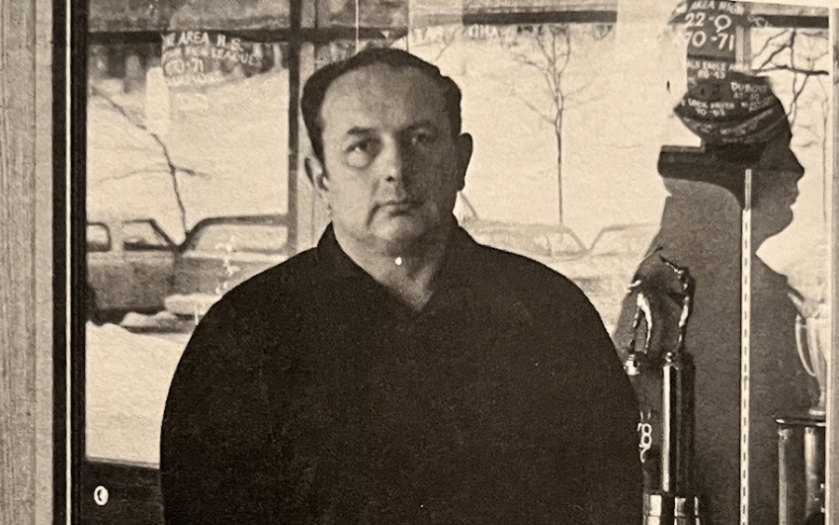
Schonewolf left a legacy of defense and toughness
The Tyrone football program was in need of a change in 1964.
Over the preceding four seasons, the team had been led by Ron Corrigan, a man who had mastered taking the abstract strategies of the game of football and giving them life through 11 players on a gridiron. Corrigan’s players described him as professor-like, mild-mannered and kind. Some, like his three-time starting quarterback Tom Miller, went as far as to call him a genius.
But after his Golden Eagles went 1-9 in 1963, it was clear the program didn’t need a MENSA candidate leading the team. What it needed was a little toughness, and it found it in a young coach named John Schonewolf.
Over the next two seasons, Schonewolf would take Tyrone from the outhouse to the penthouse in the Central Counties Conference, and put the Golden Eagles back into the conversation of just who was the top team in the Western Conference, which in those days meant an awful lot. Some tricky math and a few strange games prevented Tyrone from winning that title under Schonewolf’s watch, but in short time he restored credibility to the program and set the stage for magical seasons to close the decade.
For those who played for him, he was, as Tom Templeton said in the 2021 book The Tyrone Football Story, “a god.”
Schonewolf passed away on Tuesday, July 15 at his home in Hickory, NC at the age of 87. He left a strong legacy as a teacher and father, but in Tyrone he may be best remembered as a coach, one who saved the football program from falling apart more than once.
Shonewolf actually had three different coaching stints at Tyrone, where he was also a history teacher. Prior to that he was quite the player himself – captain of his high school team at William Penn in Harrisburg and a Central Penn League all-star as a senior. He later attended Lock Haven State Teachers College, where he where would earn honorable mention as a tackle on the Pennsylvania State Teachers College all-conference team.
Schonewolf came on at Tyrone as an assistant under Corrigan in 1960, but his first years as a head coach came in 1964 and 1965, the seasons when the Golden Eagles returned to the primary ethos of the game of football and became aggressors and hitters once more.
In 1964, the Eagles were led by players like Templeton, Bill Gearhart, Bruce Tepsic, Terry Turnbaugh, Tony Singer, Don Friday, Max Schnellbaugh, and Charlie Soellner, among others. Gearhart was one of a group of players who had vowed as kids, after watching Tyrone fall inches short of a Western Conference title in 1956, that he and his friends would be the first at Tyrone to win a Western Conference championship in football and a Mountain League title in basketball.
It was a big dream, but Schonewolf was all about the larger picture. Though in general his coaching tactics would be considered old school in 2025, many of his philosophies were very much cutting edge, including competitive, high-energy practices, opening up the offense with a pro-style look, and vowing to throw to ball 70 percent of the time in his first season.
That rate of passing never came to fruition, but Tyrone did revolutionize its offense under Schonewolf, in an era when “three yards and a cloud of dust” was still very much the norm; his team in 1964 became the first at Tyrone to eclipse 1,000 passing yards for a single season.
The big win of the campaign came in Week 9 when the Eagles knocked off defending champion Lock Haven 6-0 thanks to a late touchdown run from Gearhart. Perhaps still on a high from the tide-changing victory, they tied 6-3 Hollidaysburg a week later in a game where the Golden Tigers never scored an offensive touchdown, and by the mathematics of the Saylor System, which was the ratings formula used then to determine a champion in the Western Conference, a tie was as good as a loss, and the title went to Northern Cambria.
But Tyrone did pick up a Central Counties championship, and Schonewolf was named Central Counties Coach of the Year. (Later, the basketball team did win the school’s first Mountain League championship in 45 years.)
| Year | Record |
| 1964 | 8-1-1 |
| 1965 | 7-2-1 |
| 1975 | 4-6-0 |
| 1976 | 5-5-1 |
| 1977 | 3-7-1 |
| 1978 | 6-4-0 |
| 1991 | 1-9-0 |
Many of the key players from 1964 returned in 1965, with one key addition: Gary DiDomenico, who had opted not to play football as a junior because he wasn’t fond of Schonewolf, came back out, and he helped to anchor a defense that may well be the best that has ever taken the field at Tyrone.
The team lost to Bellwood-Antis in the season opener, but it regrouped quickly and put the clamps on its competition at a rate never seen before or since. The Eagles shut out seven consecutive opponents, outscoring teams 179-0 over a seven-week stretch that included perhaps the most heralded finish in school history. In Week 4, Tyrone and Huntingdon were tied 0-0 with just seconds remaining, and the struggling ‘Cats, who held possession of the ball as time wound down, were more than happy to accept the draw. But rather than take a knee on the final play, quarterback Ken Fagan pushed himself into the line and had the ball snatched from his hands by DiDomenico, who ran it back 30 yards for the game-winning touchdown as time expired.
The Eagles would finish the season 7-2-1, and as quickly as the promising Schonewolf era began it was over. He took a new coaching job in 1966 at Cocalico Union, where he went 1-9, but that one win was one more than Cocalico had achieved the two previous seasons. A year later, he was coaching in Pottstown, where he stayed for five seasons, winning a Ches-Mont League championship in 1971 and earning Ches-Mont Coach of the Year honors.
From there, it was on to York Suburban and then Reading before coming back to the borough in 1975. By then, Tyrone’s program had fallen on some hard times in the latter stages of the career of Steve Magulick. The Eagles had gone 4-6 in 1972, 3-7 in 1973, and 4-6 in 1974, after which Magulick left to return to his native town of Spangler to coach at Northern Camrbia. A promising decade that began with the Year of the Eagle in 1970, when the Eagles went 8-1-1, was quickly coming off the rails before Schonewolf returned to steady the program.
While Schonewolf’s second term wasn’t the overnight success of his first, he did manage a 5-5-1 season in 1976 before going 6-4 in 1978, Tyrone’s first winning campaign in eight years. It was after that season that his son Doug was named to the UPI All-State first team as a lineman.
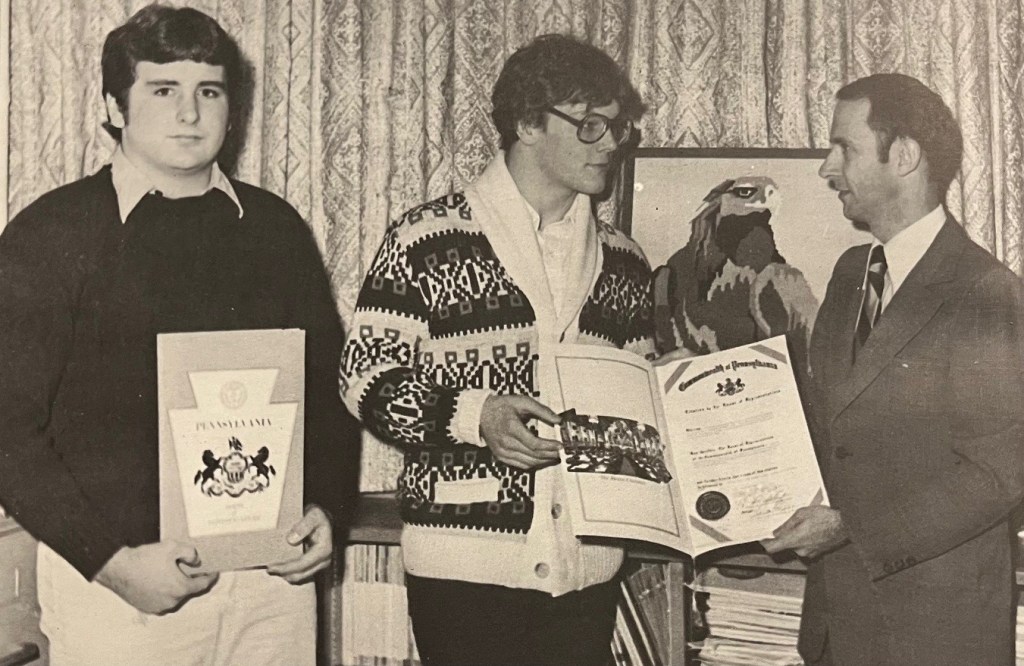
Miller took the reigns of the program in 1979, and Schonewolf settled into his role as a world history teacher, but he would make one more brief, and impactful appearance on the sidelines at Gray-Veterans Memorial Field before it was all said and done.
By 1991, the Eagles had fallen into something much worse than mediocrity. In fact, mediocrity would have been an improvement at that point. Tyrone went 1-9 in 1989 and 2-8 in 1990. The ’89 season was the capper on a three-year run from Chuck Hoover, while ’90 was the one-and-done career of former NFL lone snapper Tim Stone, whose departure in February of 1991 left Tyrone with a big problem: who was going to coach the football team?
Thirty-seven candidates applied for the job, but it was Schonewolf who took the team in ’91. He was someone the school board and athletic director Pete Dutrow trusted to provide stability and get the program back on track. Schonewolf’s appointment was sweetened by the fact that he had just retired in the spring of 1991. While many men in his position were considering retirement getaways and bucket lists, he was back at the old school. working to save the program he helped to build.
The team finished 1-9, but it wasn’t for a lack of effort or structure. Tyrone was entering a strange period of its football history, when years of losing had almost made the game a second-tier sport. The top athletes were no longer all about football – many didn’t play at all – and it was going to take a special group to bring it back.
In the end, Schonewolf’s career at Tyrone ranks among the best. He finished with a 34-34-2 record over seven seasons (his 34 victories ranking fifth among all coaches at Tyrone), and his work outside of the borough showed he could coach just about anywhere.
Beyond that there was the man himself. He was a giant figure in the school district, a huge personality who could hold a class’s attention with a spellbinding, narrative approach to history that in itself was unique for the time. He was a leader, a department chair, and a servant in his community – a man who believed the best one could do to serve their country was to solidify the home.
His tough persona as both a teacher and a coach often belied his loving nature. Before retiring in 1991, it was Schonewolf, in one of his final acts as department chair, who spearheaded an initiative to build a solid oak table for the school library in remembrance of close friend and colleague John Weymer, who had died two years earlier after battling cancer.
Schonewolf understood that through strength and stability, individuals and groups can thrive, whether they were players on a football field or citizens of the United States. He provided the football program with much needed stability more than once, bridging the gap between coaches, eras and styles with dignity.
 ORANGE AND BLACK
I played for Coach Schonewolf on the 75 & 76 teams. He was a great coach and very good to me. He was tough and had great knowledge of the game.
Mark Stever
LikeLike