

No. 1: Tyrone’s championship uniforms under Franco remain untouched
John Franco had a big job ahead of him when he arrived in Tyrone in1994.
He was tasked with reviving a program that was only then beginning to show signs of life after five years of stagnation.
The team hadn’t had a winning season since 1988. Athletic leaders at the school district wanted a year-round program. The locker room facilities were in near disrepair. And voices around the community were calling for the Eagles to leave the Big 8 and join a different conference, one more their speed.
It was a lot to think about for a guy who had recently been fired from his coaching job in Altoona and had been contemplating taking a year off just to clear his mind.
On top of all that, Tyrone had been using the same uniforms for more than a decade, the once-proud orange pants with black squares looking more and more like relics from ancient history as the 90s neared their midpoint.
What he was being asked to do was to perform a complete overhaul.
Luckily for the athletic committee and the small group of boosters who enticed him to come to Tyrone, Franco was uniquely suited for the job.
Coaches come in all sizes and shapes. There are those who are practice coaches, and to them the game is almost secondary. They live for every two-hour session and pour themselves into preparation. Bobby Knight was like that.
Others are gamers, strong in advanced scouting and film study, and probably content to allow their assistants to handle much of the day-to-day drilling of fundamentals.
Another category of coaches is the architect, the one who constructs a program from the ground up in his own image. He’s comfortable, even confident, in tearing down what came before, all the way to the foundation, just to build it again to the specs of his liking. This coach has a hand in everything, and nothing goes unnoticed. These coaches have staying power because they’re going to see the building job through to the end, if only by sheer force of will.
The late John Hayes, who coached Bellwood-Antis for 38 seasons, was one of those guys, and his imprint is still seen on the program today. The Blue Devils still wear the same helmet design he popularized, and they play on a field that bears his name.
Justin Wheeler at Bishop Guilfoyle is certainly a contemporary example of another, as is Homer Delattre at Hollidaysburg.
Franco was also one of those guys, so he wasn’t overwhelmed by the task he had in front of him when he accepted the job at Tyrone in February of 1994. Like a lumberjack hacking away at a hearty oak tree, he knew the job wouldn’t be completed with one swing, so first thing’s first.
What that meant was building on the momentum the program gained in 1993, when a four-game winning streak to close the season allowed the Eagles to finish at .500 for the first time in years. He did that, and even had the team contending for the Big 8 and a playoff spot all the way up to the final weeks of a season that ended with Tyrone 5-5.
There was still much to get done, so a uniform change was on the back burner during Franco’s first season. The team wore the same orange pants with black squares on the legs that they had worn throughout the Tom Miller era in the 1980s, along with the orange helmets Miller had introduced in ’86.
It wasn’t until 1995, in the season-opener against Bellwood-Antis, that Tyrone unveiled new gear, but even then the complete outfit was a year away from the iconic uniforms that characterized Franco’s tenure. Orange pants were out, with the Eagles instead opting for white, with a black/orange/black stripe down the legs. On top, the team went to white helmets for the first time in a decade, with a black/orange/black racing stripe and an orange T on each side.
When the outfit was completed, it looked very much like a throwback to the 1970s, but in ’95 one piece was missing. For away games, when the team wore white-on-white, it still wore the jerseys from the previous season, with orange stripes on the shoulders.
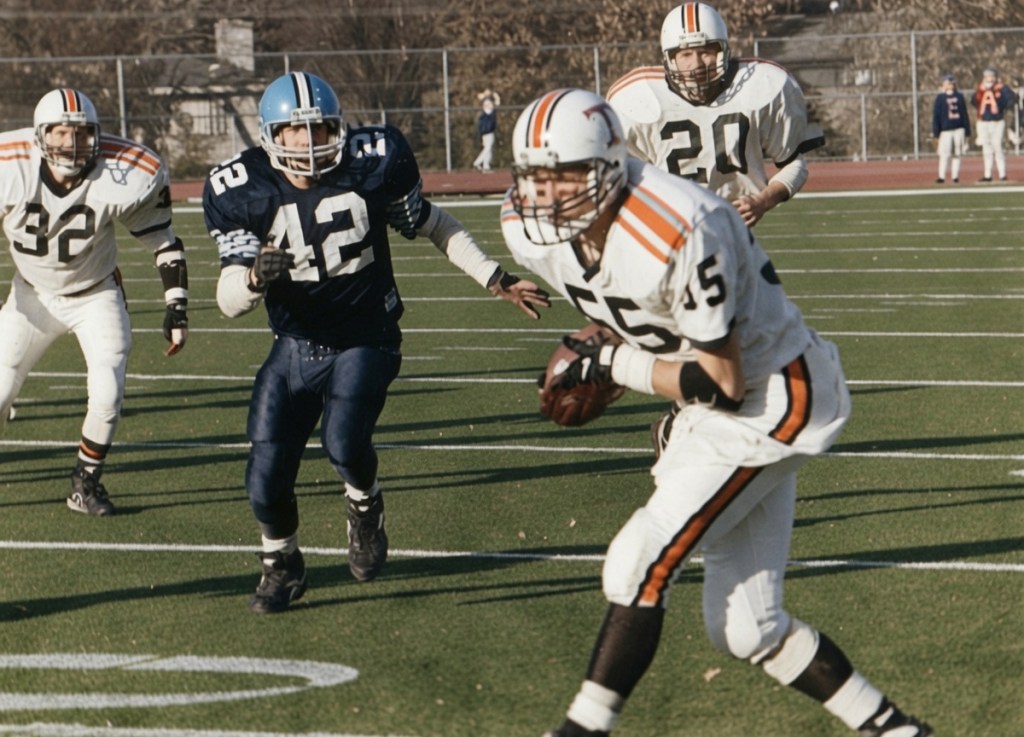
It was the right change at the right time because Tyrone was ready to turn a corner. After blasting B-A to begin the season (you can watch it here), the Eagles won eight straight before losing in the regular season finale to Indian Valley. They went on to won the program’s second District 6 title and eventually played in the PIAA final four.
By 1996, the entire uniform – home blacks and road whites – was completely manifested on game day. The jerseys were plain black with white trim and eagles on the shoulders or plain white with orange numbers and orange eagles on the shoulders.
In opting for those particular uniforms, Franco said he wanted to make them as simple as possible, something just short of Penn State blandness. For him, it was much more about how the players performed rather than what they wore, but in selecting a uniform as plain as the ones he did, he created an iconic look, one that fans still cling to and still talk about.
The white-on-white combos are a particular favorite, and in 1996 it was the gear of two of the program’s biggest games. The first was in the PIAA quarterfinals, on the road against Wilmington in Sharon. Tyrone used an epic drive that spread from the third into the fourth quarter to score a go-ahead touchdown late in a 14-10 victory.
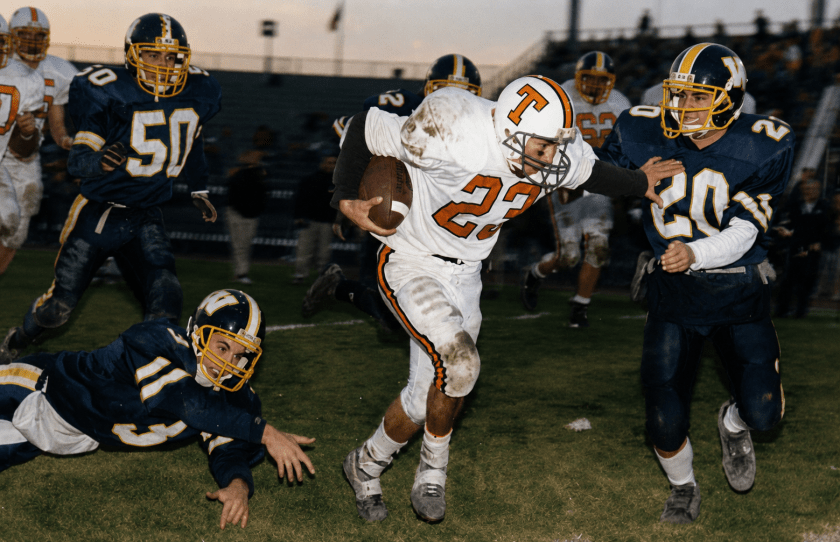
After another come-from-behind win in the semifinals over Aliquippa, one in which Tyrone wore its black jerseys, the Eagles were back at Mansion Park to play in the PIAA 2A championship. Until 1998, Altoona was the host of all PIAA championship football games, so the Eagles’ game against Mount Carmel had an electric atmosphere very much like a home game.
That didn’t stop the Red Tornadoes from scoring a 25-6 win, but Franco and Tyrone had established themselves as up-and-comers on the statewide scene.
The Eagles would win a third straight District 6 title in 1997 before eventually making it back to the PIAA championship in ’99. Once again, the road whites played a memorable part in the journey when Tyrone travelled to West Mifflin just outside of Pittsburgh to play WPIAL champion Waynesburg in the final four.
Decked in white, the Eagles recorded an epic goal line stop at the end of the first half and went on to win 17-13 to advance to the state championship, which was now played in Hershey.
Tyrone wore its black tops for that one, a rematch of the ’96 finals against Mount Carmel, a team that won three PIAA titles in the ’90s and added two more at the start of the 2000s. On a postcard, the conditions would have looked exemplary for mid-December, but the truth is the wind was a major factor for both teams throughout.
Down 6-0 to begin the second half, the Eagles took the lead on a pick-6 by Tim Dry early in the third quarter.
The score remained 7-6 late in the final frame when Tyrone was backed to its own 9 trying to run out the clock. The problem was, if the Eagles didn’t convert a first down, they would be punting into gusts that were killing kicks and passes all game. They turned to All-State back Jesse Jones and the same sweep left that had secured the District 6 championship three weeks earlier against Forest Hills.
And Jones delivered. On second-and-11, he took the pitch, cut off a kickout block from fullbacks Josh Lucas and Josh Taylor, and was off to the races, going 91 yards for the game-clinching score in a 13-6 victory. (Here is one look at it, and here is another from the television broadcast).
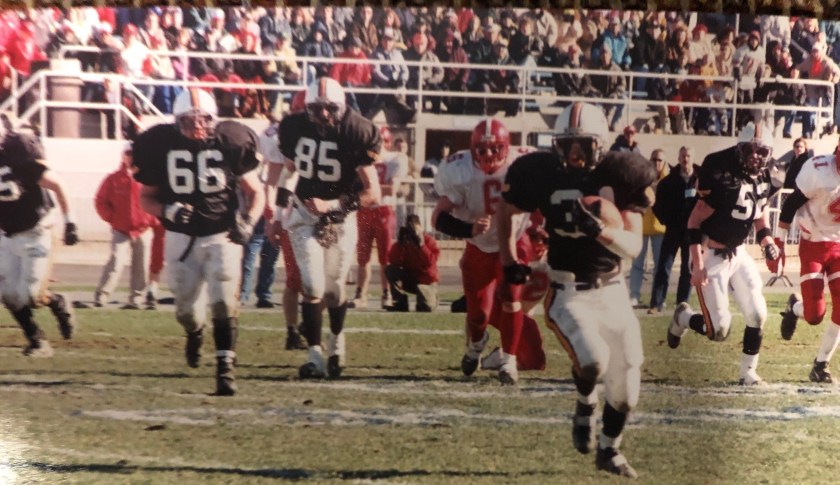
It was official. Tyrone was the best football team in Pennsylvania, and those simple and plain uniforms weren’t going anywhere.
The Eagles repeated as District champions in 2000, and after a couple of rebuilding seasons were back in the title game in 2003, this time defeating Forest Hills wearing black jerseys.
They would win it again in 2004 (again in black with a win over Bishop McCort), before donning white to issue another epic beat down on a WPIAL champion in the PIAA quarterfinals. That season, Seton LaSalle had been bowling over opponents with a revolutionary passing game that had set national records led by quarterback Bill Stull, who would go on to become a first-team All-Big East passer playing at Pitt.
But Tyrone wasn’t enamored of the records. Playing at East Allegheny High School, the Eagles limited Stull to 11-for-20 passing with three picks and three sacks. Meanwhile, Brinton Mingle powered to 118 yards on 23 carries in a 28-7 win.

The Eagles would lose in the semifinals a week later to Grove City in the infamous credit card game played in State College, but despite the loss the program was in the midst of something epic – a 35-game regular season winning streak that wouldn’t come to an end until 2008.
During that time, when teams faced Tyrone they were playing against more than just a team. They were playing a machine, one where every piece was a moveable part of a whole. It was almost like you could plug in anyone anywhere and the machine was going to keep producing wins. The system was that good.
So when starting running back Johnny Franco was out for most of the 2007 season, it didn’t matter. Wide receiver Shayne Tate moved to running back and ran for 1,000 yards. The next season, Larry Glace moved from the offensive line to the backfield and did the same.
In 1995, Franco built the program on a fresh group of kids who were hungry to win and to be the team that made things right again. By the 2000s, kids were hungry just to get on the field and be a part of it all. The backups were often as good as the starters, and any opening to get playing time was an opportunity.
Tyrone’s uniforms fed into the mystique that now surrounded the program, the white helmets with orange T’s cutting an intimidating look for lesser teams peaking across the 50 during warmups.
By the time the streak came to a close in a nailbiter against Clearfield, Tyrone was almost ready to begin another big-time run. By 2009, Stevie Franco took over as Tyrone’s quarterback, and the Eagles would play for a District 6 championship in each of the next three seasons.
They would win it in 2011 wearing their black tops, but as was the case before, some memorable wins came in the whites, like a 2009 victory over Central in the District 6 semifinals. It was a game played in the Cove and a rematch of a 14-7 Dragon victory in the final week of the regular season. But behind a stellar defensive effort that saw Eric Desch record a pick to seal the win, and some gutsy running from Levi Reihart, the Eagles pulled off the 7-0 upset.
In 2011, though, it was all about the blacks as Tyrone wore its home tops for the final seven games of the season, including a District championship win over Richland, PIAA wins over Hickory and Aliquippa, and a PIAA championship loss to Lancaster Catholic.

Franco departed after the season to return to coaching in Altoona, but the uniforms stayed after Steve Guthoff took over in 2012.
Jason Wilson switched things up when he became Tyrone’s coach in 2014, moving to black pants and even opting for black helmets by 2015, but when Franco came back to coach in the borough in 2019, the first thing he did was switch the threads back to the familiar ones he popularized during his first stint.
***
It’s hard to say precisely how or why certain uniforms become iconic, but winning certainly has a lot to do with it.
Over two coaching tenures and 25 years in Tyrone, Franco won 230 games and eight District 6 championships. That’s a lot of good times and a lot of positive vibes for the fanbase, so it’s little wonder the Franco-era uniforms hold a special place in the hearts of so many.
But all things come to an end, and one of the few certainties in life is change, so the day will come when Tyrone moves on from the iconic uniforms that came out of the Eagles’ 90s explosion.
And maybe the next set will be the next great Tyrone uniforms.

