
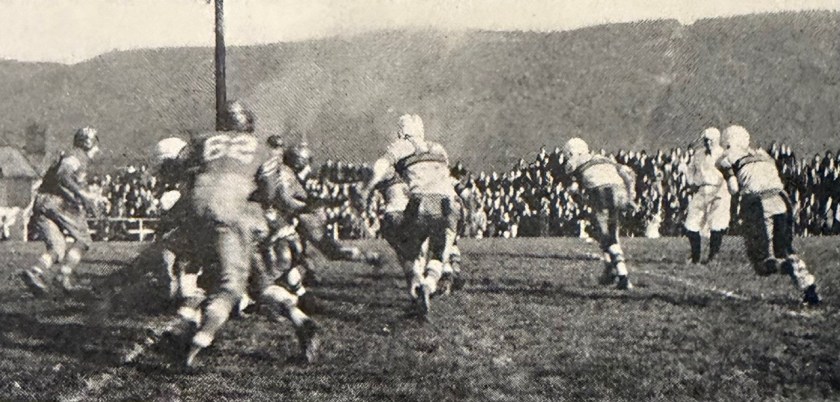
Holiday game was once a staple of Tyrone’s yearly slate
If you’re a high school kid in Pennsylvania playing football on Thanksgiving these days, it truly is an event for which to be grateful.
That’s because in 2026, if your season is still going strong in late November, you’re making a push for a PIAA championship. Quarterfinals in all six classifications will take place Friday and Saturday this week, and those teams fortunate enough to be playing will start their Thanksgiving celebration not with a Turkey Bowl game but actual practice.
However, well before there was any systematic way of delivering a true state champion in Pennsylvania, many teams played Thanksgiving Day games, and Tyrone was no different.
For two decades early in the 20th century, the Golden Eagles played on Thanksgiving, and more often than not, the ultimate outcome was one that could only be soothed by a hot bath and a slice of mom’s pumpkin pie. But while the results were rarely in Tyrone’s favor, the Thanksgiving game day experience produced some of the most memorable contests from the formative years of the school’s storied program.
ALL-TIME BACKFIRE
The essential ethos of the Golden Eagles’ program has always been grit and determination over all else. It’s one of the reasons Tyrone is 5-1 against schools from the WPIAL in the PIAA playoffs. While it would hard to argue most of those teams had greater talent than the Golden Eagle teams they were facing, they may have lacked the overall determination to grind out a game for four quarters.
That has never been a problem in Tyrone, and a lot of it goes back to 1921, when high school football first became a thing in the borough.
After a local young man named Benjamin Rich was killed in 1897 in a game between teams from Tyrone and Bellwood, the sport was outlawed for high schoolers in the borough for a quarter-century, and school aged boys caught playing the game anywhere near school property risked expulsion.
Fears of traumatic injuries and fatalities hampered football’s growth in Tyrone, but that was on par with the rest of the country, which grappled with the safety of the game decades into the 20th century, and still does today in many ways.
But by 1921, Tyrone’s Footloose-like reaction to Rich’s death had subsided to the point that it was ready to put a team on the field, and it was a team that was all grit. What little equipment the players had was shabby, at best. Many players wore shirts and pants stuffed with old newspapers functioning as pads, while others rigged church shoes for cleats.
The team was composed of 11 players: Cliff Albright, James Stewart, Howard Woodring, Jack Dietrich, Clark Giles, Martin Miller, William Thompson, Jack Nash, Jack Baldridge, Milton Mills, Frank Stonebraker, Jack Giles, Al Smith, Wilbur Ammerman, and Franklin Grazier.
Many of the best were underclassmen – some as young as eighth grade – and accounts of their games in the press often noted that the team learned a thing or two about how the game was meant to be played.
Not surprisingly, there wasn’t much winning going on in 1921. After topping Curwensville 6-0 in the program’s inaugural game, the Orange and Black – as they were then called – lost seven in a row, scoring just one more touchdown the rest of the way.
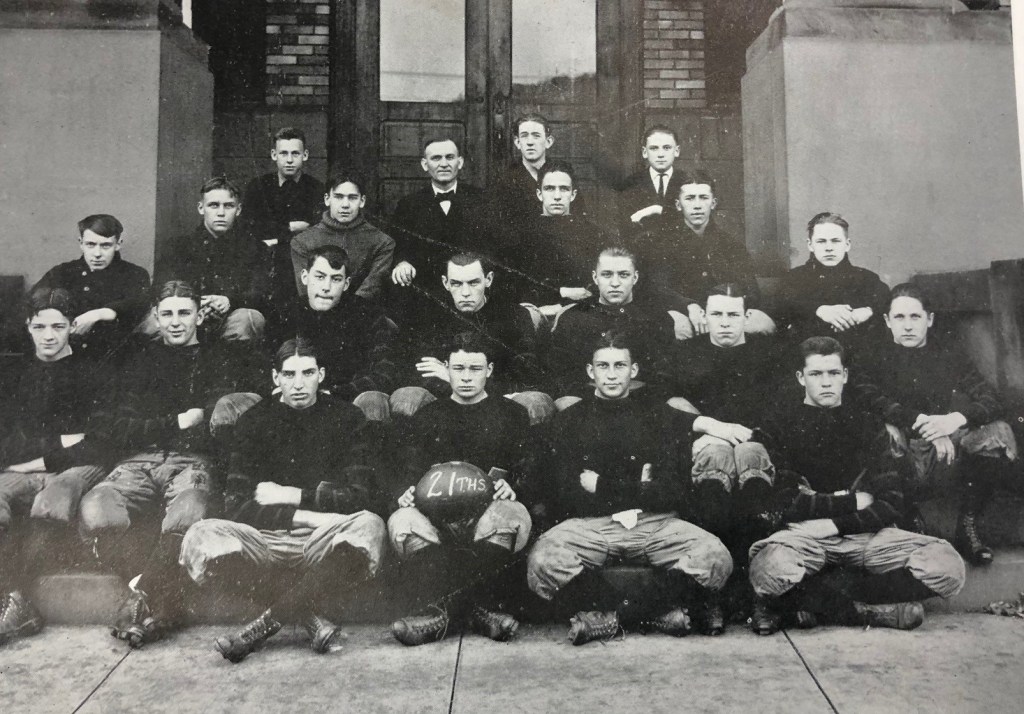
If not grit, you’ve got to at least have a passion for the game to keep going under those circumstances, but there was some light at the end of the tunnel as the season drew to a close. Organizers scheduled a game with Altoona on Thanksgiving that was a lock.
For Tyrone to play Altoona’s varsity at this stage of the team’s development would have been foolish. The Maroons finished 1921 4-5-1 and their best years were about a decade away, but they were still a level above the Orange and Black. Instead, Tyrone’s first Thanksgiving game was scheduled against the Tenth Ward Juniors, which was essentially an independent neighborhood team. In 1921, the unit averaged 130 pounds per man.
The juniors played a slate of scheduled games but frequently picked up games when called upon, and that’s just what Tyrone did. “In order to get a little consolation out of the season,” the Tyrone Daily Herald reported, “this Altoona team was hooked for the Thanksgiving day game because it was believed Tyrone High would be able to defeat (them).”
Altoona had other ideas. The juniors downed Tyrone 6-0 at the Athletic Park in a game that was “rough all the way.” Altoona’s Clifford Albright got a broken nose while Jack Deitrick sustained a badly sprained arm. One Tyrone player was disqualified.
The loss ended a rough season for Tyrone, but Thanksgiving Day games would continue, and Altoona would later remerge for the holiday affair, only the next time the game wouldn’t be played against the city’s mites.
THE CLIMB
Tyrone was better in 1922, though it didn’t show in the win-loss record. The Orange and Black finished 2-9 but avenged an embarrassing 61-7 loss to Mount Union from the previous season and won its first Thanksgiving game with a 25-0 win over Mifflintown.
A storm was coming. The talented underclassmen that had helped spearhead the formation of a football team in Tyrone two years earlier were coming of age in 1923, most notably Wilbur “Wib” Ammerman, who was only an eighth grader in 1921. By 1923, he was leading the team with strong play from the quarterback position, guiding the Orange and Black to a 6-3-1 record. That included a 70-0 win over Juniata on Thanksgiving when he scored six touchdowns.
Tyrone was now on the precipice of something big, and with each Thanksgiving Day game they were inching closer and closer to the big dogs of Blair County – the Maroon and White of Altoona.
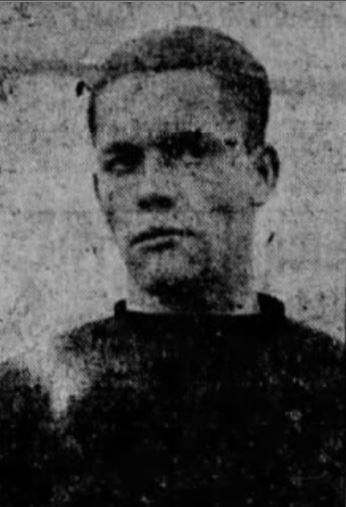
The next season, the Orange and Black posted its first undefeated regular season, marred mildly by a 0-0 tie with Altoona, but capped with a 20-0 victory over Hollidaysburg at Dysart Park on Thanksgiving.
This was a meteoric assent for a unit that had scored just 12 points three years earlier while wearing outfits that somewhat resembled football gear. However, the team came back to earth a year later after Ammerman, who was one of the most highly-touted players of his era and led the state in scoring as a junior, made a transfer to Bellefonte Academy, a prep school known for turning out athletic talent. Its most famous alum was John Montgomery Ward, who played 16 seasons in the Major Leagues, challenged the Reserve Clause, and wrote the book Base-Ball: How to Become a Player, with the Origin, History and Explanation of the Game. In 1964, Ward was inducted into the Major League Baseball Hall of Fame.
Tyrone would bottom out at 2-5-1 in 1926, claw back over .500 in 1927, and battle for a 5-5 split in 1928, all while Hollidaysburg stayed on as the traditional Thanksgiving game. In five holiday matchups, Tyrone held the upper hand with a 3-1-1, but the opponent was about to change on the day of giving thanks, as was the tenor of the holiday because entering the schedule on Thanksgiving for the 1929 season was Altoona.
For the Orange and Black, there wouldn’t be much to be thankful for, but there would be an awful lot of giving in a holiday series that couldn’t have been more lopsided.
CRICKETS
That Tyrone and Altoona would grow into football rivals seems almost inevitable in retrospect. In the 1920s, these were the two biggest cities in Blair County (With a population over 9,000, Tyrone was then a city in every respect) and the two most important stops in Central PA for the Pennsylvania Railroad. That would change in 1929, when the Tyrone Division was absorbed by surrounding divisions, signaling a slow but certain decline of the PRR’s influence in the borough, but up to and for some time after that point, Tyrone was a powerful piece of the commonwealth’s rail network. And that’s one of the reasons the football team had such a nice facility for games.
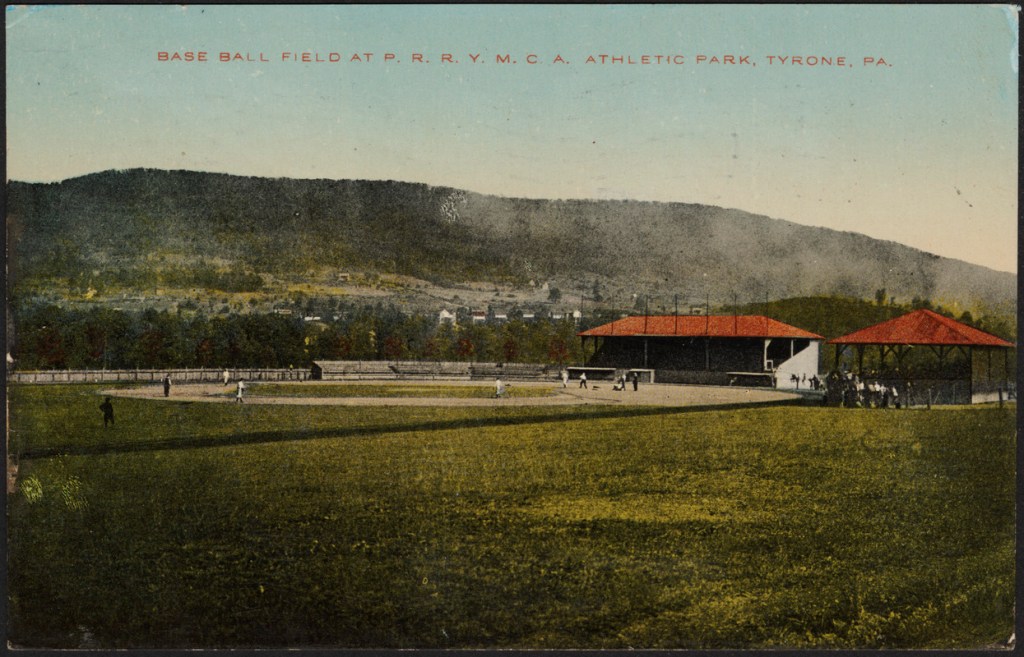
A sports oasis in a desert of green, the Athletic Park was the Pennsylvania Railroad’s finest gift to the borough of Tyrone, springing up as a way for the Pennsylvania Railroad to help merge the two communities of Tyrone and East Tyrone.
East Tyrone, which ran from Eighteenth Street to Twenty-Third Street, was incorporated as an independent borough in 1873, with its own school, churches, and stores, all the amenities one would expect from a growing town, which East Tyrone was in the latter part of the 19th Century thanks to the railroad and the shops it had opened up there in 1868.
Rivalries brewed between Tyrone proper and East Tyrone, and they often resulted in fisticuffs between young gangs from each community, which would meet at Stoney Point, an area where now sits the American Legion on Fifteenth Street, to do battle.
The boroughs merged in 1893 and the PRR, sensing the friction between the communities and realizing their destiny lied not as rivals but partners, made a move to counter the situation.
Tyrone was growing considerably in population and prosperity thanks to the railroad, but it lagged in several important areas. One was the absence of a central high school, and the other was the lack of recreational outlets on a scale suitable for a community of Tyrone’s size. This was an era when cities across the United States were beginning to recognize the importance of recreation for those who labored long hours in mills and factories, and many began to address these needs with the development of open spaces into parks whose names resonate to this day. Central Park in New York opened completely in 1876; Schenley Park in Pittsburg came soon after in 1893.
J.K. Johnson, Superintendent of the Pittsburgh Division of the Pennsylvania Railroad, was dispatched to Tyrone to aid in the merger of the two towns, and while he helped push for a new high school building on Lincoln Avenue and Twelfth Street, he is best remembered for ingenuity in developing the Pennsylvania Railroad Young Men’s Christian Association Athletic Park.
Johnson had become more than the Superintendent of the Tyrone Division. He made his home in the community, residing in the house that is now the American Legion, and his noble vision for the Athletic Park reflected an emotional connection. The highlight of the park was its baseball diamond, with a covered grandstand that seated 1,000 spectators, but there was also a running track and a golf course. For those fortunate enough to obtain passes, there was an Olympic-sized swimming pool with a bathhouse that stretched the length of the waters, behind which sat a lagoon with a stone gazebo in the center. The Athletic Park had six tennis courts, croquet grounds and picnic areas, inviting out-of-towners to visit by train on weekends to pass the day.
This was the height of imperial Tyrone, and the grandeur of the park was never lost on those who had the pleasure of spending a day there.
The Athletic Park absolutely rivaled Altoona’s Cricket Field as the top sports facility in Central Pennsylvania
A legendary sports complex located in an area near the Altoona shops by what would become Altoona Hospital on Chestnut Avenue and Seventh Street, Cricket Field was likewise built by the PRR. The Wendy’s restaurant that now sits in its place like a lump in a sea of Macadam parking spaces gives no hint to the fact that in its heyday in the early 20th Century, Cricket Field was a jewel.
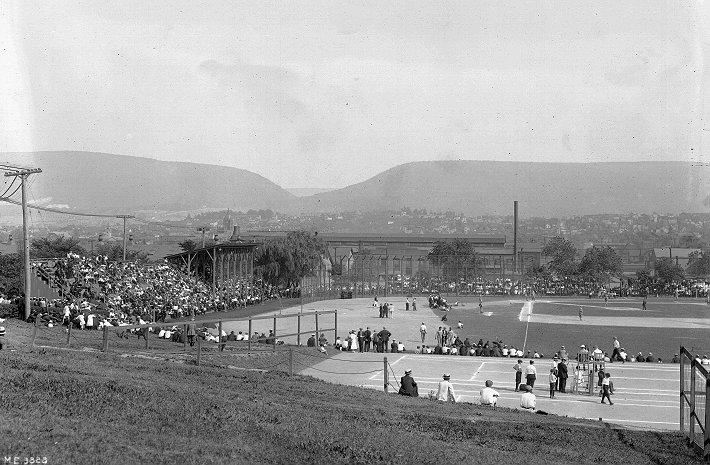
Much like the Athletic Park, it was a multi-purpose sports facility, but its main calling card was baseball. The host of city league and Pennsylvania Railroad league games, as well as the unofficial neutral site for the Homestead Greys of the Negro Leagues, Cricket Field played host to players like Josh Gibson and Satchel Paige, as well as many Major Leaguers who came through on barnstorming tours. Just a month before Tyrone and Altoona squared off in 1924, Babe Ruth played at the field, belting what was touted as the longest home run in the history of the ballpark, reportedly travelling more than 500 feet over center field. Cost of a general admission ticket that day was $1.00.
Tyrone and Altoona battled for county football supremacy throughout the 1920s, with Tyrone topping the Maroons twice by identical 6-0 scores in 1925 and 1926.
The loss in 1926 was an indignation Altoona couldn’t bear. Believing the game wasn’t called on the square by official Lynn Hutchinson, who was a Tyrone resident, Altoona refused to renew its contract with the Orange and Black, and the game was put on the shelf until 1929.
When the game did return to Tyrone’s schedule, it was played as a Thanksgiving matinee, but this time the backdrop was not Cricket Field, but Mansion Park, which opened that same season. And while the renewed series was often a contest with high stakes, it was completely dominated by an Altoona squad that was reaching its early-20th century apex.
In nine games, the Maroon and White – who became the Mountain Lions in 1935 – went unbeaten against their sister city rivals – who took on the moniker Golden Eagles in 1932.
And it was never close.
In those nine games, the Mountain Lions outscored Tyrone 277-25 with six shutouts. And while Altoona was producing some of its best teams of all time – the Mountain Lions went 93-14-6 with two unbeaten seasons during this period – Tyrone wasn’t too shabby either. Under Walter Mensch and then George Kavel, the Eagles had three eight-win seasons and one where they won nine during the same time frame, which made the Thanksgiving Day matchups hot ticket items.
The game back in 1924 had drawn 11,000 spectators to Cricket Field, and that figure remained constant once the rivalry was renewed in 1929. The Logan Valley trolley line frequently added extra cars to bring a contingent of Tyrone fans to Mansion Park, a throng that reached as many as 4,000 people in 1931, but in all cases those fans left unhappy.
In 1937, the last time the two teams met in a high school football game, Tyrone went into Altoona 9-0-1, with the newly formed Bald Eagle League championship already in hand. But the undefeated Mountain Lions crashed the Eagles dreams of an unbeaten season with a crushing 39-6 victory.
Altoona finished 11-0 as a first-year member of the WPIAL, but was not awarded the conference title after it turned down a postseason game.
For Tyrone, two things were coming to an end. For one, it was time to get Altoona off the schedule. For another, Thanksgiving games weren’t going to be a big part of the future moving forward, but not until a switch to the schedule brought another rival to the holiday game.
BRING ON THE ‘CATS
One impetus for saying goodbye to Altoona was what was becoming a competitive imbalance, but another was that Tyrone, like Altoona, had recently completed a new home stadim of its own – Gray Memorial Field on Hamilton Avenue and 17th Street. Built by WPA workers during the Great Depression and paid for partially by funds bequeathed by Adda M. Gray, Gray Field opened in 1934 to a chorus of cheers across Blair County. The school district had been searching for a more centralized field closer to the high school on Lincoln Avenue than the Athletic Park on 23rd Street for years, and when land became available several blocks away, it was the perfect opportunity.
So after dumping the Mountain Lions after 1937, Tyrone finally had the chance to host its own Thanksgiving game, but the Eagles would have to wait one extra year. In 1938, the first season for legendary coach Steve Jacobs, the Eagles travelled to Huntingdon for the holiday, falling to the Bearcats 12-0.
Jacobs would go on to become the winningest coach in school history, producing 11 championships and 100 wins, but 1938 was a transitional year, when the Eagles finished 5-6-1.
In the one Thanksgiving game played in Tyrone the following season, Tyrone avenged its loss with a 13-6 win over Huntingdon that allowed the Eagles to finish the season 11-1, a Week 2 loss to Clearfield all that separated them from a Western Conference championship.
It’s difficult to imagine now, when the PIAA has divided the commonwealth into six classifications that feed into District, regional, and state playoff games, but throughout the 1920s, 30s, and 40s, (unless you were a member of the WPIAL), a Western or Eastern Conference title was the top prize. To win it, a team would normally have to traverse a regular season without a loss, and even then there were no guarantees as a convoluted system of ranking points ultimately determined the winner.
For 18 seasons from 1923 through 1940, the winner of the Western Conference then faced the winner from the Eastern Conference in the Central Pennsylvania High School Football League championship game, which was widely regarded as a state championship.
Tyrone had climbed the mountain towards that game for a decade but always fell short until 1940. That season, the Eagles won their first Western Conference title and ultimately played to a tie with Shenandoah in the CPHSFL championship game, thus earning a share of a state championship.
But none of that could have happened without a Thanksgiving win over Huntingdon at the Bearcats’ new facility, now known as War Vets Field. Both teams were vying for the Western Conference crown.
Tyrone came away with the win, and a little bit of plunder.
In front of 7,000 spectators, Bud Noel opened the scoring in the first quarter, capping a 79-yard advance with a 3-yard touchdown run. Frank Ammerman then set up his own touchdown in the fourth quarter with an interception before scoring from two yards out in a 13-0 win that sent Tyrone fans into a frenzy that had not been seen before and has not been duplicated since.
And that’s probably for the better.
Overcome with elation, Golden Eagle fans stormed the field and tore down signs that read “Bearcat Eats Eagles,” along with one of the wooden goal posts. Huntingdon fans weren’t going to just stand by idly and endure the indignation, so a confrontation followed in which, the Daily Herald said, fists were thrown and anatomies were bruised, but down came the goal post. It, along with the signs, was transported back to the borough for the celebration.
Tyrone was going to the state championship game, and it was time to party. Unfortunately for the Tyrone faithful, someone forgot to tell the fire marshal.
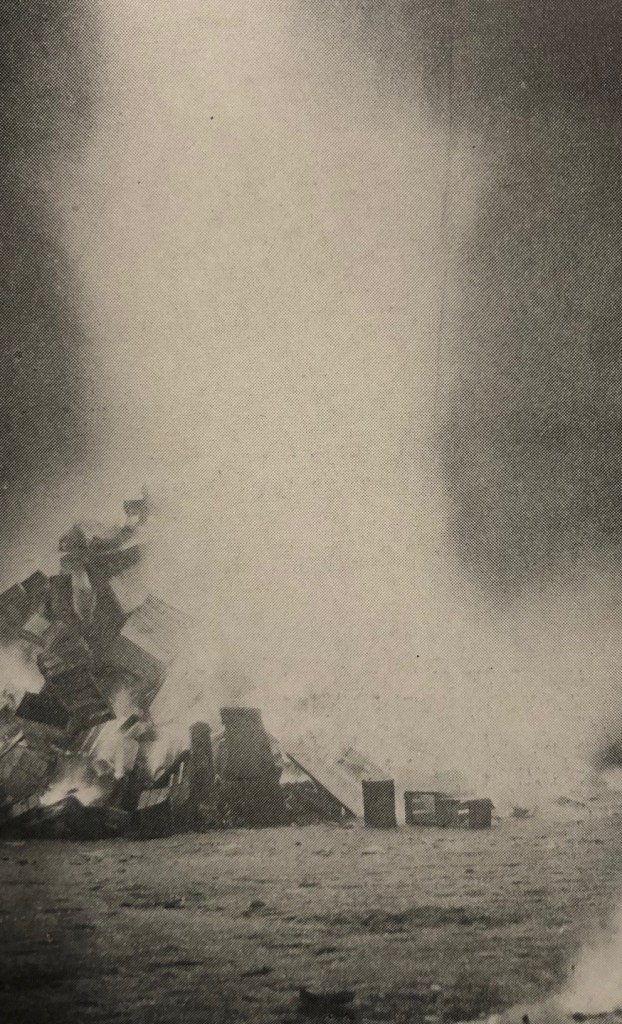
In 1940, the intersection of 10th Street and Pennsylvania Avenue was the busiest intersection in the borough. On the night of November 28, 1940, that area had to have appeared like something out of a dream to car riders rolling through on their way to State College or Williamsburg or any number of communities not familiar with a Tyrone victory celebration. That’s because townsfolk built a bonfire at the intersection, using as tinder, among other things, the wooden goal post requisitioned from Huntingdon, as well as the signs confiscated in the initial celebration. Fans also threw on wooden and paper boxes, crates, paper, and generally anything flammable that would add to the blaze.
Open fires in city streets are rarely a good thing, no matter what the impetus, but when the fire rose high enough to tickle the traffic lights overhead, Tyrone’s police and fire fighting forces were on the scene to bring the blaze under control and clear up the area.
EPILOGUE
No one could have known amid that celebration but things were about to change – dramatically and in many ways. The CPHSFL halted its East-West championship game the following season and never picked it up again, which meant PA’s only game approximating a state championship was gone. Pennsylvania schools would not compete for a state title for another 48 years after the PIAA formalized a playoff system in 1988.
The world itself became much darker in 1941. Just weeks after teams played their final regular season games, Japanese forces escalated tensions that had been brewing for months by attacking US forces at Pearl Harbor, and the effects this action had on the country were unmistakable. In the world of Pennsylvania high school football, living in a country at war often meant seasons were often cut short or eliminated altogether, schedules were altered to limit travel expenses, and thousands of young men left their teams when they reached enlistment age.
More broadly, the US was unified in a war effort unlike anything the nation had ever seen as it manufactured a war machine and emerged from the Depression as the unquestioned world power. The harnessing of atomic energy brought on a Cold War that altered world relations for the next half century.
More than 6 million Americans would play a part in the war effort, with over 400,000 paying the ultimate sacrifice.
Tyrone’s football team itself saw three former players lose their lives in service of their country – Bob Bickel, Terrance Weston, and Stanley Catich, all of whom played in the 1940 championship game.
As for Thanksgiving games, Tyrone would never play another one. In 1941, a year the US had two Thanksgivings as FDR and his administration worked to codify an official date for the holiday, the Eagles ended the season with a win over Hollidaysburg on Armistice Day, and by 1942 the final game of the slate frequently came on Saturday afternoons.
For Tyrone, Thanksgiving would play no part in the season again until the 1980s, when, like successful teams do today, the Eagles practiced over the holiday in preparation for the 1987 District 6 championship, which was played against Huntingdon at War Vets Field.
Thanksgiving remerged in the 90s and 2000s as a badge of honor – if you were practicing on the day of thanks, you had already been crowned District champs and were eyeing a bigger prize.
Because of those playoffs, it’s unlikely Tyrone will ever play another Thanksgiving game. Such games still exist in PA, mostly in and around Philadelphia, but in Central Pennsylvania, by that point in the year, a team is either entrenched in the postseason or completely packed up as its players go through winter sports drills.
Clearly Thanksgiving football is a staple of the holiday for Americans. In 2025, NFL games averaged more than 44 million viewers per game on Thanksgiving. But the high school Thanksgiving game stands as a reminder of a bygone era, when communities converged to celebrate the day by cheering on their young athletes.

