
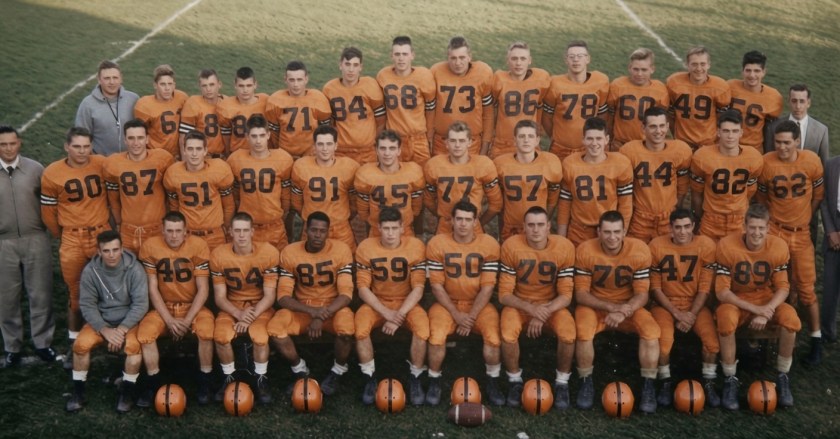
No. 7: Early 50s orange-on-orange
Steve Jacobs was the man who truly put Tyrone football on the map.
Before he took the coaching job in 1938, the Golden Eagles produced teams that were always in the mix, always on the cusp, but always one key win away from the big one, which in the 1930s and 40s was a Western Conference championship.
George Kavel was ready to get the team over the hump in 1937 when he led the program to its first league championship, capturing the newly minted Bald Eagle League crown, but it was on a different tier than a Western Conference title, and before the trophy had enough time to collect dust in the display case Kavel was gone. He departed to coach at Mount Carmel and enjoyed a fairly successful run in the Coal Region.
That brought in Jacobs, and where others before him hit to the warning track, he swung for the fences. After a 5-6-1 rebuilding campaign in 1938, Jacobs led Tyrone to an 11-1 record in 1939.
In 1940, he went one better – an undefeated regular season (12-0), the program’s first Western Conference championship, and a spot in the Central Pennsylvania High School Football League championship game against the winners from the Eastern Conference, Shenandoah (Kavel’s Red Tornadoes went 9-1-1 that season and just missed out on winning the championship berth).
The game, played at Shenandoah in rain, sleet, and mud ended in a 0-0 tie, so Tyrone shared what was then recognized as a state championship. Not bad for a coach in his third season. But Jacobs was far from finished. He would ultimately lead his teams to 10 conference and league championships, including five Western Conference crowns (although 1940 was the last time East and West played in an overall title game).
When Jacobs finally stepped down at Tyrone in 1952 to coach at Lock Haven State Teachers College – now Lock Haven University – he had amassed 100 wins, a number never approached until John Franco took over in 1994.
Even as Jacobs came along at just the right time, taking over a program with clear expectations and lots of talent in the pipeline, he left at the right time, as well. In his final season, the Eagles finished 2-9, and it wouldn’t get better for Tyrone from there. In his only season in the borough, Jim Pletcher went 2-8 in 1953 before John Chuckran took over in 1954 and produced the program’s first winless campaign, going 0-9-1. (It was ultimately changed to 1-9-1 after it was disclosed that Lewistown used an ineligible player in its 29-0 pummeling of the Eagles).
Post-Jacobs, Tyrone had just two more winning seasons in the 50s and finished with two or fewer wins four times. It would be until the mid-60s before the Eagles once again had championship seasons, and it would take until Franco arrived in the 90s before the program rolled in a second golden era, when championships seemed to grow on trees and Tyrone looked down from Olympus on most 2A teams in Pennsylvania.
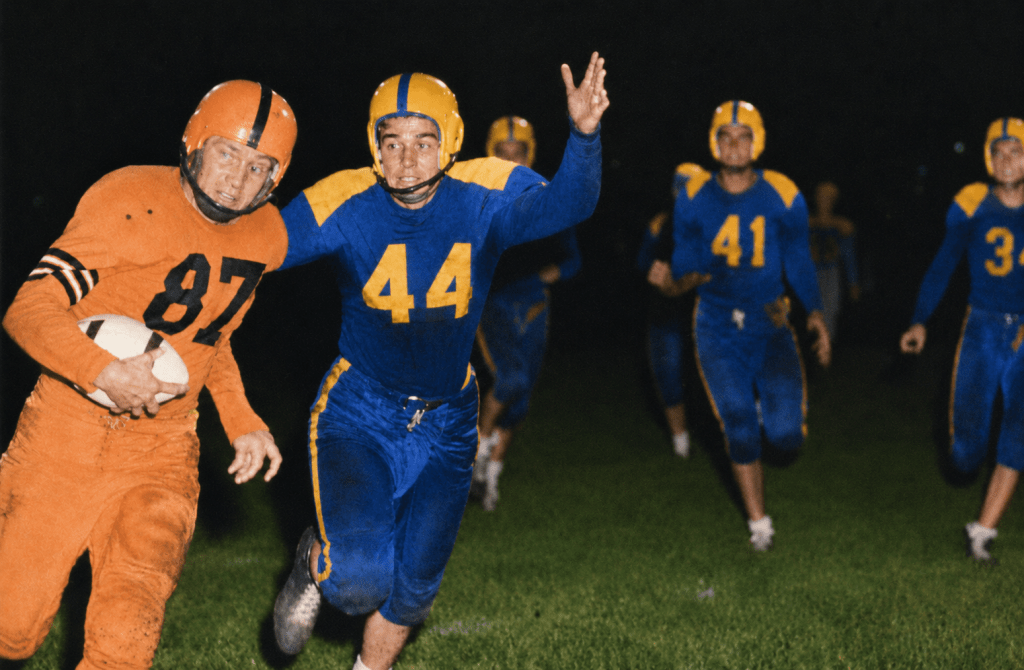
Jacobs was without a doubt an innovator. He installed an offense known in the 40s as razzle-dazzle, using the forward pass and trick plays as well as anyone.
His last bit of innovation came in the fashion department.
Jacobs’ final team at Tyrone went all in on the orange in Orange and Black, donning orange jerseys, orange pants, and orange helmets. And while the stylish duds didn’t do much to enhance the team’s play between the lines, it created a look that was memorable.
The uniforms hit the field in 1951 and were used through the 1954 season. No team at Tyrone had ever gone all orange before then, so the uniforms were certainly unique, as was the idea of orange helmets. Throughout the program’s early years, Tyrone, like practically every other school, used leather Zuppke helmets, which featured an internal suspension system to reduce the impact from head-on-head collisions. John Riddell began manufacturing plastic helmets in 1939, but they weren’t employed on a mass scale until after World War II, when plastic shortages limited their production.
Before plastic headgear, coloring helmets was not easy. Leather helmets were usually black or brown so coloring them meant painting them, but plastic helmets could be produced in one solid color.
The uniforms lasted only four season because when John Chuckran became head coach in 1954, he had a different vision for the Eagles’ overall appearance, and it didn’t include orange at all. He outfitted Tyrone in black and gold in a look that was just as brief but nonetheless iconic.
Other teams would bring back all-orange uniforms in later decades, starting in the mid-60s, but none of them went as far as to include orange helmets, opting instead for white and in one case black, so Jacobs’ final innovation truly did represent a moment in time.
When he began winning title after title in the early 40s, Jacobs ignited a string of success like nothing Tyrone had ever experienced, one that wouldn’t be duplicated for a half a century.
The all-oranges, on the other hand, still haven’t been duplicated. So while Franco was able to take Jacobs’ spot in the record books, no one has yet taken his last innovative move that at the very least made some low points in the 50s bright and fun from a fashion standpoint.

