

No. 6: Black helmets in 1963
By all accounts, 1963 was a year of missed opportunities for Tyrone’s football team.
The Golden Eagles finished just 1-9 that season, but it certainly wasn’t for lack of talent. Their roster was like a who’s-who of 1960s football in Tyrone, players who would go on to become all-conference and All-State athletes.
But for one reason or another, something wasn’t working in ’63, and a team that was one year away from winning a conference championship languished, losing eight straight after its lone victory in Week 2.
Another missed opportunity that season came in the wardrobe department. In a bold move, Coach Ron Corrigan outfitted his team in black helmets – Tyrone’s first experiment with black lids – and coupled with a new jersey design and uniform combo it created a striking visual.
But like the Cascades, who made it to No. 3 on the Billboard charts with “Rhythm of the Rain” that same year, the uniforms were a one-hit wonder. John Shonewolf ditched the black helmets when he took over in 1964, and they wouldn’t be seen in Tyrone’s locker room for another 50 years.
To say Tyrone’s roster in 1963 was capable would be a gross understatement. The Eagles were young, to be sure, but there was greatness up and down the lineup, none better than sophomore Tom Templeton, who by his senior season was selected to two All-State teams and played in the Big 33 game. Starters in ’63 also included junior quarterback Bill Gearhart, who would go on to make the all-Central Counties team in 1964 and score 1,000 points in basketball; sophomore Gary DiDomenico, who would one day become a Central Counties all-star and PIAA wrestling champion at 180 pounds; and Chuck Soellner, another future All-State and all-conference lineman.
Perhaps ’63 was a year of acclimation. Gearhart would have been the starter in 1962 before his season was derailed by a freak accident where he was hit by a car on his way to practice, so he was just getting his feet wet his junior season. The sophomores had bright futures, but varsity football is a different kind of animal, so maybe they needed a year of seasoning.
But 1-9?
The brainy Corrigan was on his way out, set to take an administrative position at Penn State, and that may have affected his own focus for the season.
There were also system and philosophical issues. By Week 6, in a 14-7 loss to Philipsburg-Osceola, the team went to a wide-open passing attack that had never been employed during Corrigan’s tenure, and while that style suited the multi-faceted Gearhart well, it was a stark shift from anything the coach had used previously.
Injuries also played a factor, after starting running back Dave Douglas broke his leg in the second game of the season, forcing even more players without much varsity experience to the forefront.
But, still, 1-9? With that talent? It’s a mystery.
The spiffy uniform change might have been the only bright spot from the dismal season, and it was nice. The Golden Eagles had been wearing black or white jerseys with orange pants for most of Corrigan’s career, which began at Tyrone in 1960. But then their helmets were orange with white and black racing stripes down the middle.
The final year of Corrigan’s time at Tyrone saw two major alterations.
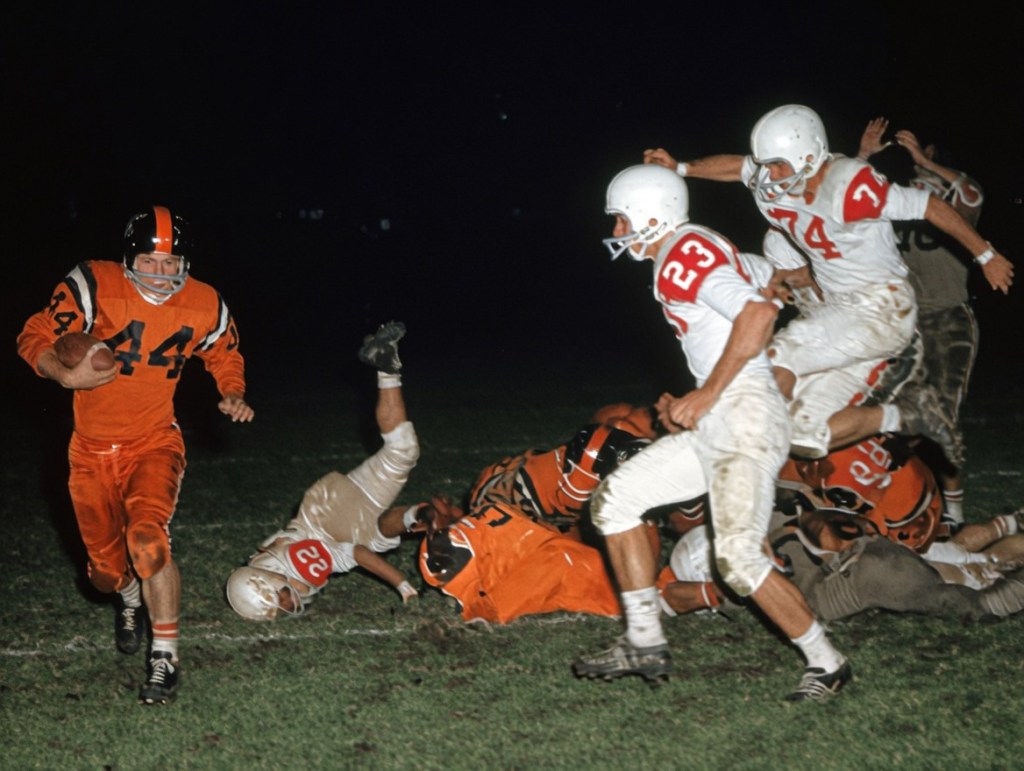
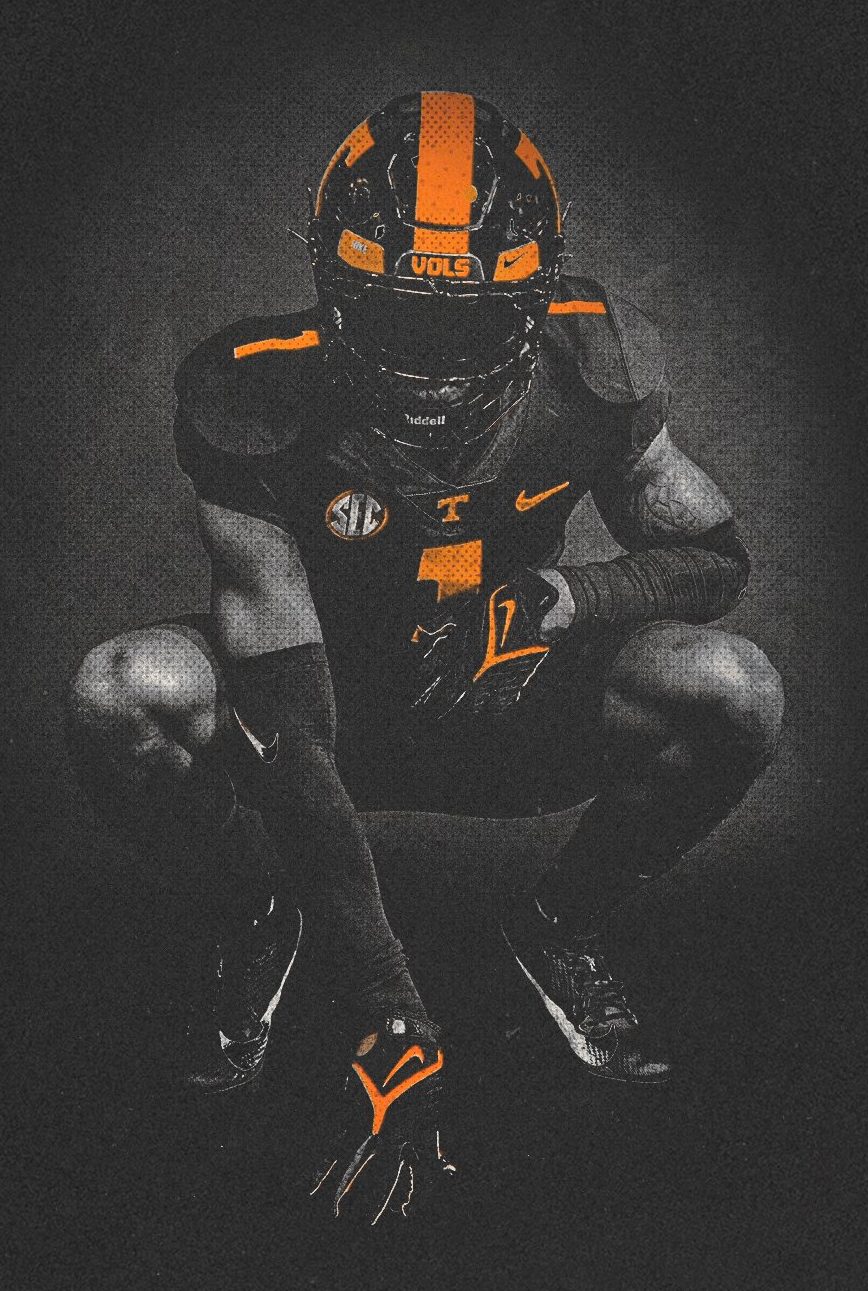
The first was the black helmet, which featured a thick orange racing stripe on top and eagle logos on the sides. Considering the University of Tennessee now wears a similar helmet as part of its “dark mode” alternate gear, it’s fair to say the look was ahead of its time.
The second was bringing back orange jerseys occasionally to offset the black ones, giving Tyrone the same orange-on-orange look that it had worn in the early 1950s.
Football uniforms on the college and professional levels became very consistent and reliable in their trim and color combinations around the 70s, 80s, and 90s, so for a generation or more, a team’s uniforms were essentially the same every Saturday and Sunday.
For better or worse, the 2000s began a time of experimentation, where many teams changed up their styles and toyed with color combos. The NFL began having color rush games and every team seemingly had an alternate uniform based on the color black. For traditionalists, that was hard to get used to.
But the fact its, Tyrone had as many color combinations throughout the 60s as a team like the Oregon Ducks today. And orange-on-orange with black lids was a good one.
Lots of things changed when Shonewolf became coach in 1964, and the helmets were the least of them. The fanatic coach who once had his team run a brutal conditioning drill he called Burma Road after a particularly stinging loss went back to a more traditional look with white helmets, but more importantly he allowed his players to be their best selves athletically.
The Eagles went 8-1-1 in 1964 and won the Central Counties and followed that up with one of several “just-missed” seasons in the the 60s a year later when they finished 7-2-1. But that season also saw Tyrone set a school record with seven consecutive shutouts while surrendering just 48 points.
After ’63, the hats stayed white until 1986, when Tom Miller revived the orange headgear he wore during his playing days in the early 60s. John Franco went back to white in 1995, and it wasn’t until Jason Wilson in 2015 that the color would change again. That was the season black helmets made their comeback.
Nineteen Sixty-Three was a monumental year by any measure. Martin Luther King delivered his “I Have a Dream” speech, John F. Kennedy was assassinated, and the Beatles released their debut album. In times like those, making a splash isn’t easy. But the Golden Eagles did, not so much with wins and championships, but with a bold color combination that foreshadowed the varied schemes of the modern era.


One comment