
No. 4: Corrigan’s return to basics
By all accounts Ron Corrigan was one of the most cerebral coaches Tyrone had ever had at the point he was hired in 1960.
He was also quite progressive. In an era when a plodding, grind-it-out version of football was still very much the norm, Corrigan was interested in speed, proficiency, and what sports eggheads today would recognize as an early form of analytics.
But for all of the forward-thinking ideas he may have employed when it came to X’s and O’s, it was his return to the basics of orange and black that helped define his coaching tenure and set Tyrone on a path of traditional colors moving forward.
Corrigan inherited a completely different look than the one he created. When John Chuckran took over at Tyrone in 1954, he outfitted the team in black and gold uniforms strikingly similar to the Black Knights of Army. It takes some moxie to come into a school and completely change the colors of the most popular sports team, but when you’ve got a player like Slug Drake backing you up, you can afford to take a few risks.
Those uniforms stayed after Chuckran left in 1957 and survived through the era of Jack Morton, whose teams were among the worst defensive squads in program history, surrendering 559 points over his two seasons.
Corrigan instituted changes. The team would run offense almost like an up-tempo basketball team. Its practices would be fast-paced and conditioning-heavy. Most importantly, the Eagles would actually try on defense for the first time in three years.
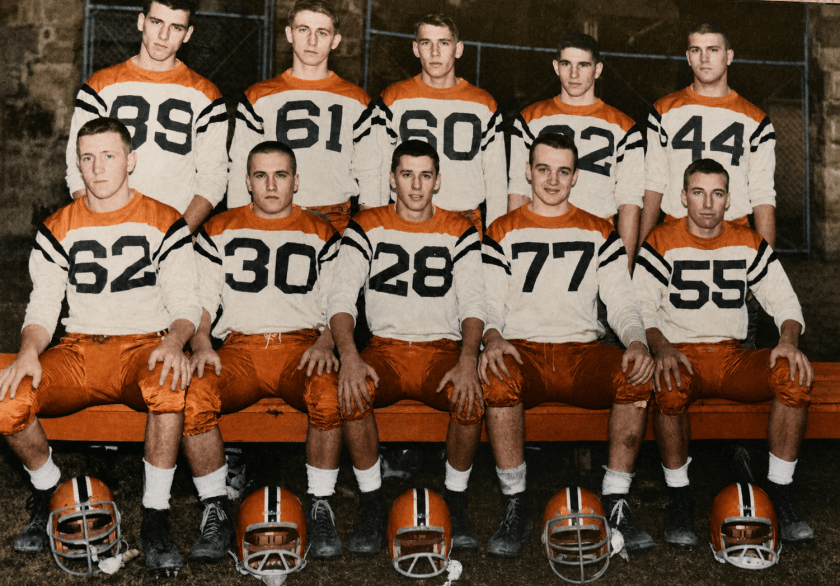
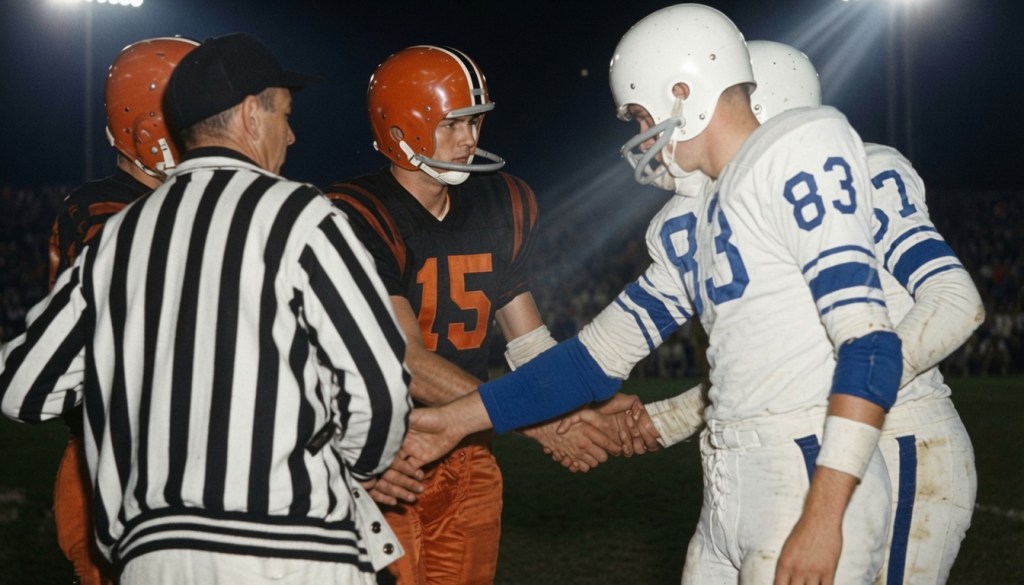
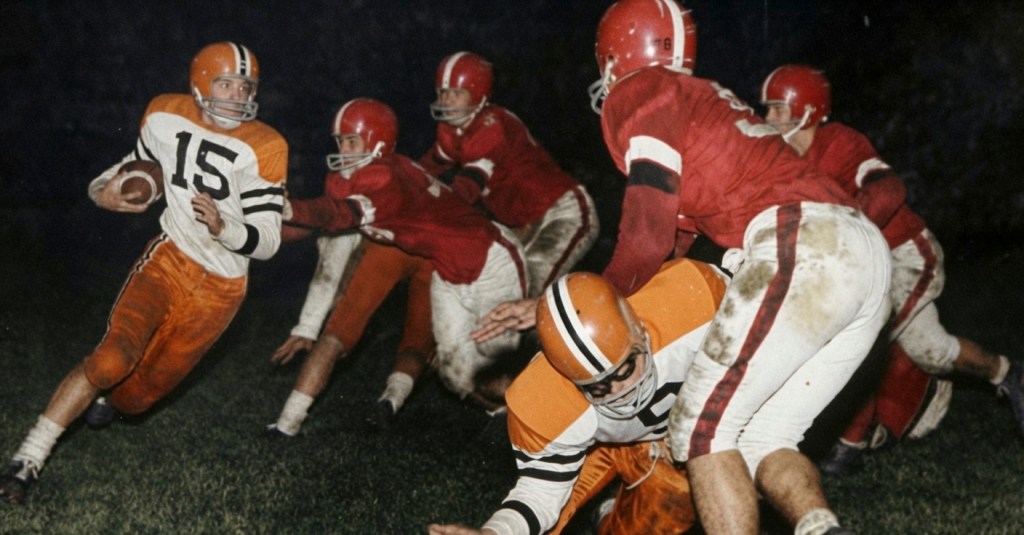
Those changes helped Corrigan revive the program, and by his third season Tyrone went 8-2 behind stars like Tom Miller and Chet Wolford. Another change was his return to orange and black, with uniforms as aesthetically appealing today as they were in the 1960s. Tyrone donned orange pants with white and black stripes and orange helmets with a white/black/white racing stripe down the middle. Their white jerseys had orange shoulders and black trim, while their black jerseys featured shoulders trimmed with orange rings.
The bright uniforms were a welcome change, as was Corrigan’s general philosophy which, as mentioned, focused on an analytical approach to the game.
The mere mention of the term analytics is often enough to make old-school fans across sports disciplines to cringe, but you take the good with the bad. It was analytics, in the early 2000s and then in the early- to mid-2010s that allowed the Oakland A’s and later the Pittsburgh Pirates to compete in Major League Baseball with lower payrolls than all of the heavy hitters. On a strategic level, detailed computer analysis informed their decision makers of appropriate times to employ defensive measures like shifts, which in turn maximized their pitchers’ strengths. At the same time, analytics are what led to management teams across the MLB deciding a .225 hitter who would strike out 180 times but hit 40 home runs was a good thing.
The same goes for the NBA, where analytics have created a game where three-pointers are highly valued because a team shooting 33% from beyond the arc scores the same as a team shooting 50% from inside the line. But while the philosophy has helped scoring to increase dramatically across the league, it would be hard to say it’s produced better basketball than golden eras like the 80s and 90s.
For Corrigan, a math teacher by trade, his use of analytics allowed him to recognize that the team that ran the most plays usually won, so his focus was on getting in and out of the huddle as quickly as possible. To that end, he didn’t waste time running plays in with a messenger. Instead, a quarterback like Miller, who went on to play at Colorado State and was himself a superior coach years later, called his own plays.
To further the initiative, his teams conditioned like cross country runners, normally completing their conditioning drills first at practice ahead of skill work and running plays.
When he had the horses, Corrigan’s teams took to his fast-paced game plan like a fish to water. But two strange anomalies outside of the uniform changes characterize his tenure.
The first was his inexplicable disdain for placement kicks. The team in 1961 that went 8-2 missed out on a Western Conference championship by a total of two points. Tyrone lost 7-6 to Lewistown and later fell to Lock Haven 13-12, and never once in those games did the Eagles attempt a kick after scoring. All three tries were runs or run-pass options, which was odd in an era when a point after touchdown was one point whether kicked or otherwise.
That was odd for a man who attended math seminars in the summer.
The other was a tragedy that befell his program in the summer of 1961, though it was hardly something Corrigan could be blamed for.
That year, a boy named Dick Park went out for the team, his first try at high school sports. At almost 6-foot-4, Park was a big kid, and that alone made him an intriguing player, but until that summer he was more of the outdoors type, an avid hunter and fisherman. In fact, his mother had explicitly asked him not to go out for football, but it’s hard to tell a growing teenage boy not to play with his friends.
Park had passed his physical exam and was cleared to play. And that’s what made his first practice even more disturbing. After a morning of intense conditioning, Park went unconscious on the practice field. He was taken to the locker room and placed in the showers to cool down, but ultimately an ambulance took him to Tyrone hospital.
Within two days, Park was transferred to Mercy Hospital in Altoona to receive treatment that was then unavailable in Tyrone.
He died a week later.
The official death certificate listed his cause of death as acute nephritis, which is an inflammation of the kidneys. That led to further complications and eventually to his demise.
Water in those days was not a priority at practice, and players from the 60s squads will tell stories of long sessions on hot summer days where water breaks were so scarce they would hide oranges in the grass on the sidelines to sneak refreshment. But it’s impossible to say the intensity of Corrigan’s practices led to Park’s death, even when taking into consideration the water issue. After all, no one else died or had remotely similar reactions.
But Park’s death does stand as a strange event form the Corrigan era that, like eschewing placement kicks, is difficult to explain.
One thing that’s not difficult to explain or appreciate is the way fans and future teams would be drawn to the Corrigan-era look. A version of the 60s uniforms would last into the 1970s, tweaked, updated, but very familiar.
So even though Corrigan left after going 1-9 in 1963 to become an administrator at Penn State, he created a legacy in apparel that would outlive him by almost a decade and serve as the wardrobe for some of the top teams of the next era.


What about the cheerleaders across the decades. That could be a nice blog.
LikeLike
I like the way you think!
LikeLike