No. 3: 60s and 70s uniforms stay true with one iconic combo
When you look at the progression of Tyrone’s football uniforms through the years, one undeniable fact holds true.
When a new coach takes over, almost as surely as night follows day, the team’s outfits are going to change. And more often than not, the change isn’t subtle.
It makes sense. A coach coming in has his own vision for the program, and that often includes uniforms. No one would expect the new guy to run the same offense as his predecessor, so why should the clothes his team wears be any different?
So when you see big changes, you often meet new coaches, and this series has demonstrated that. John Chuckran changed Tyrone’s colors and added gold to the uniforms in the 1950s. Ron Corrigan returned to orange and black in the 60s. Jason Wilson went all black in the 90s.
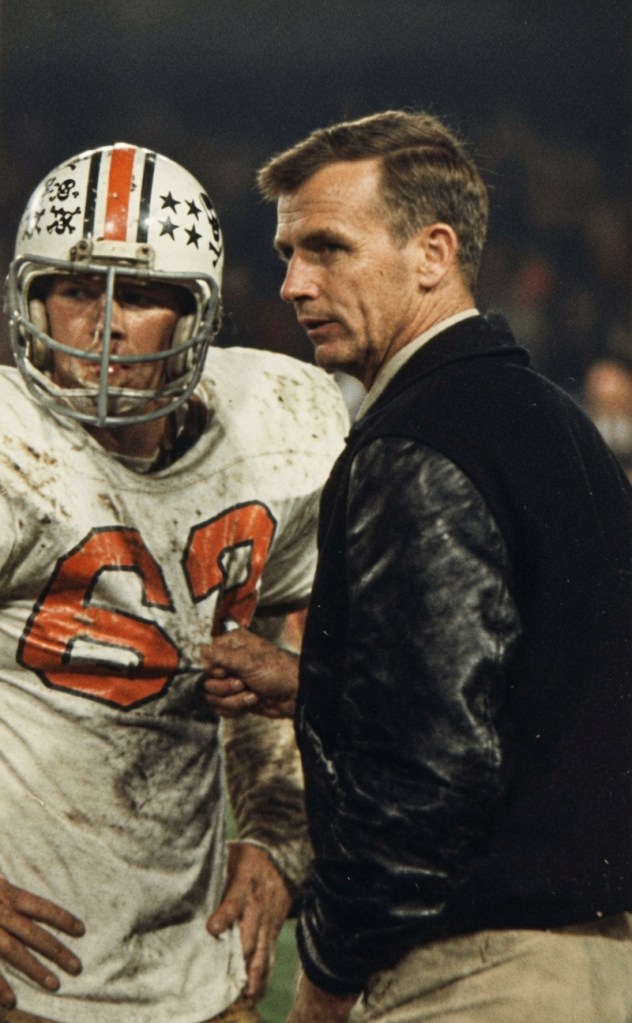
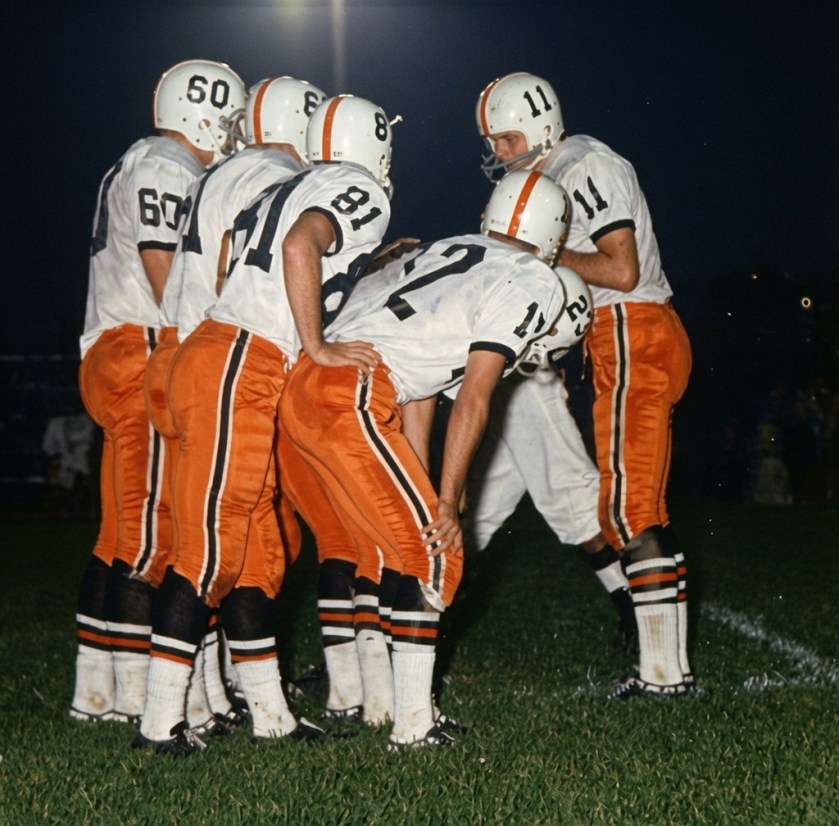
But by the late 1960s, under John Shonewolf and then Steve Magulick, the Golden Eagles put together a ‘fit so iconic that’s its major components went unchanged for almost a decade and lasted in their essential form over both coach’s reigns.
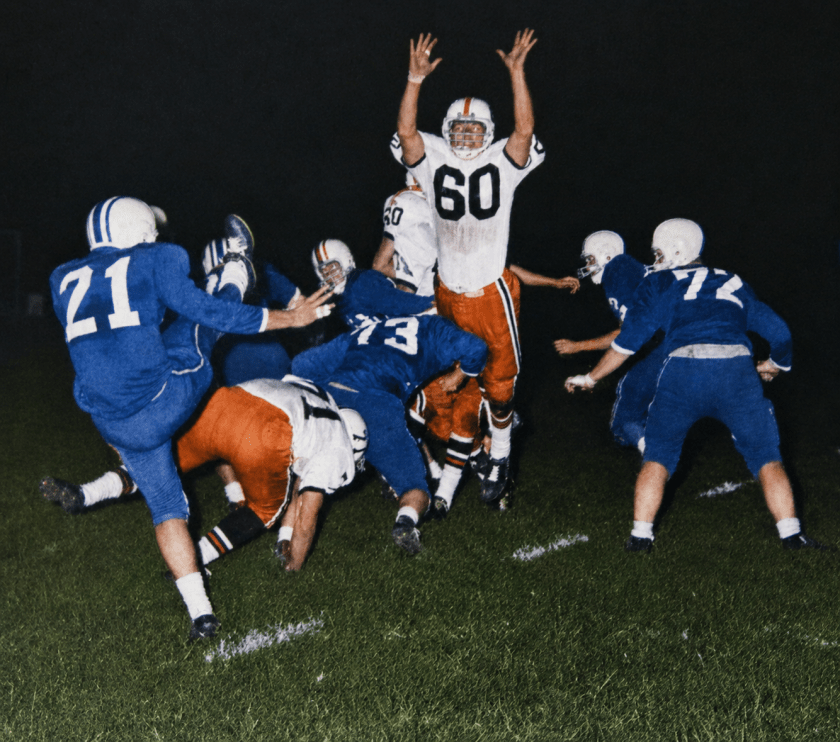
Within that uniform was a lot of room for flexibility, but the basic threads – orange pants, white jerseys, and white helmets – remained consistent and were the clothes of choice for many of the team’s best players and memorable games.
The look built off the one established by Corrigan early in the 1960s. But while his version had orange shoulders on white jerseys and black jerseys as an alternates to go along with orange lids, these made some significant changes. The orange pants stayed the same, but the white jerseys were simplified: plain white, black numbers, black trim. In a bolder move, black was out an an alternate color for jerseys and orange was in.
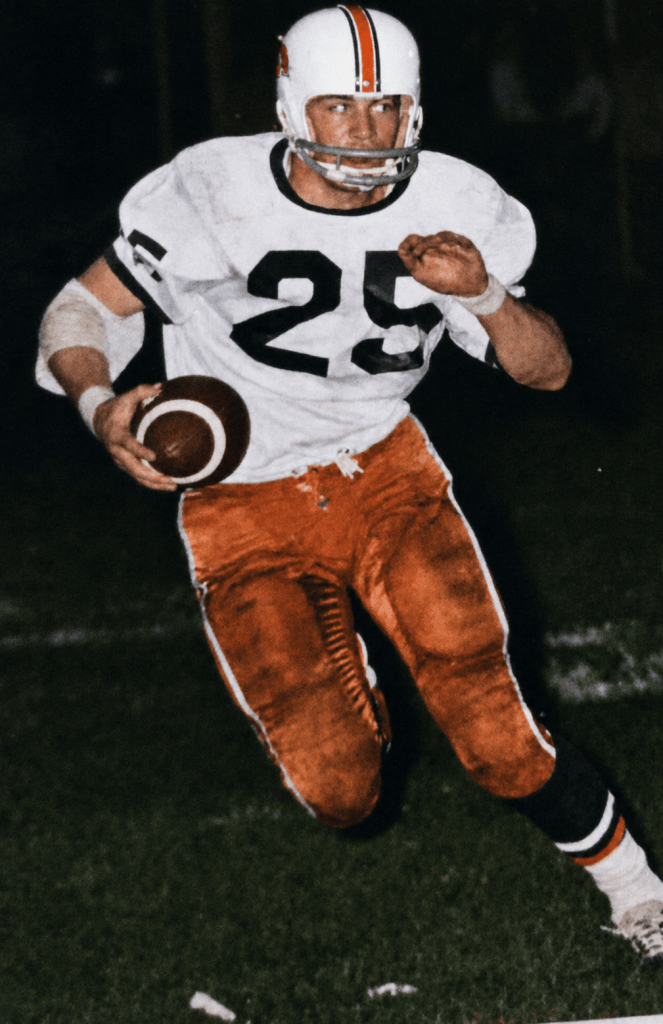
On top, the team shifted to white helmets to create a look that would last, in one form or another, through the mid-80s.
The initial change came when Shonewolf took the wheel in 1964 with a team destined for greatness. The growing pains of 1963, when Corrigan was in his final season and a young but talented team somehow finished 1-9, were gone, as was Corrigan’s overly analytic approach to the game. Shonewolf, first and foremost, was about physicality, and the team in ’64 was ready for that kind of leadership.
Behind players like Bill Gearhart and Tom Templeton, the Eagles finished 8-1-1, going from the outhouse to the penthouse in one season to win a Central Counties championship.
Tyrone’s success continued in Shonewolf’s second season, and while it didn’t produce another championship, the group certainly belongs among the pantheon of Tyrone’s finest because its defense was measurably better than any other. In 1965, Tyrone recorded seven consecutive shutouts – a record about as secure as DiMaggio’s hitting streak. Among those games was one of the most bizarre victories in program history, a 6-0 win over Huntingdon in Week 4.
The teams were tied 0-0 with time about to expire and Huntingdon merely running out the clock. At that point they were a bottom-tier team in the Western Conference and a tie from the ‘Cats perspective would have been quite nice. But rather than take a knee, Huntingdon quarterback Ken Fagan went head first into the line, twisting as he did. That put the ball within the reach of defensive lineman Gary DiDomenico, who stole the pigskin and ran 30 yards as time expired to win the game.
That DiDomenico was even playing was nothing short of a miracle. The future state champion wrestler didn’t play as a junior because he didn’t like Shonewolf, but he was a conference all-star in 1965, when the Eagles surrendered just 48 points.
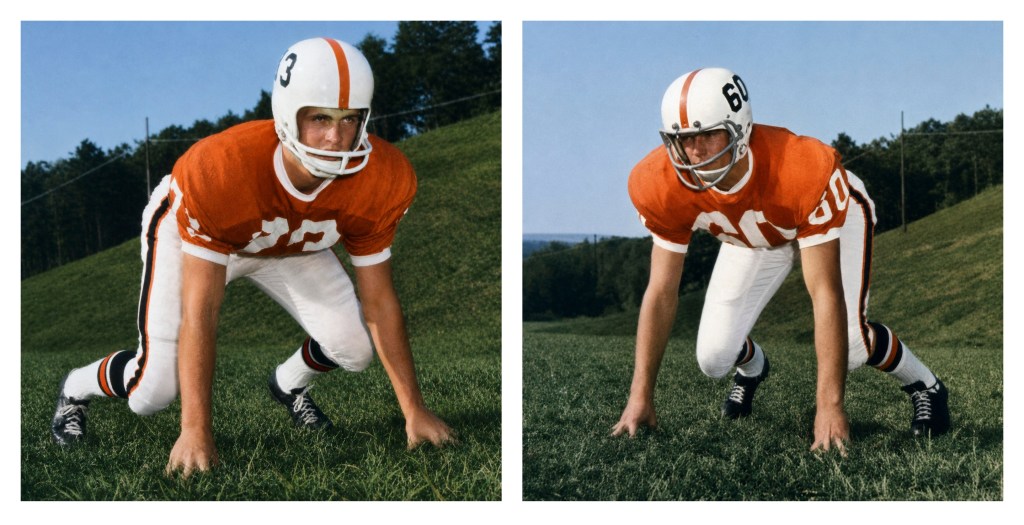
Tyrone’s uniforms were simple during the Shonewolf era, but orange jerseys with white pants was something new and pleasing, and the helmets – white with a single orange stripes and black numbers on the side – remain an old-school look that isn’t talked about enough.
When Shonewolf departed after the 1965 season to coach at Cocalico Union, he was succeeded by Steve Magulick, who stayed eight seasons and departed the program and the school as one of the most revered coaches and teachers of his time.
Magulick inherited a program loaded with talent, and he did a lot with it. Some of the top players in program history played for Magulick – thousand-yard rushers and All-State performers – and they won a lot of games in the late 60s and early 70s.
But his era also coincided with two events he could have never controlled that factored into Tyrone’s slow descent from football significance as the 70s progressed.
For one, in December of 1970, the Westvaco paper mill, the town’s major industry, closed its pulp mill and shut down three machines, thus cutting 550 jobs. It was an industry like Westvaco that made living in the borough from cradle to grave a favorable proposition because it provided jobs one could obtain straight out of high school and keep through retirement, but the 70s was a difficult time all over for the paper industry.
Beyond that, the construction of the Route 220 bypass, now known as I-99, destroyed entire neighborhoods at the eastern ends of 10th, 11th, and 12th streets to make way for ramps and a bridge spanning Bald Eagle and Brush Mountains. It’s easy to look at the area now and think it’s always been that way, but those areas at one time were the location of around 150 homes and almost 500 residents.
When the brilliantly designed beaux arts masterpiece that was Grand Central Station in New York was demolished in 1963, art critic Ada Louise Huxtable said in her essay “Farewell to Penn Station” that “we will probably be judged not by the monuments we build but by those we have destroyed.” She was lamenting not a highway, but the deteriorating culture of a city that will “get what it admires, will pay for, and, ultimately, deserves.”
But the point applies to the 220 bypass and most major highway projects of the time. What the nation and the state wanted in 1970 (stemming from Eisenhower’s interstate highway act in 1956) was connectedness and more convenient routes for automobiles. And if that meant some homes had to be sacrificed along the way, so be it.
But you get what you pay for, and nothing happens in a vacuum. For Tyrone, those two events cost the town residents and voters (in 1970 alone the town reported a loss of 800 voters), and when families fled the borough, the talent pool for athletes shrunk.
There would still be stars on the gridiron in the Magulick era, but the depth of the championship teams of the 1940s, when the backups to the backups could have been starters, was gone, and it wouldn’t return until the late 90s.
What that meant for Tyrone and Magulick was that in a landscape where big schools like State College, Lock Haven, and Hollidaysburg would always be a part of their Western Conference and Central Counties schedules, the Eagles were less and less equipped to match those schools man-for-man as the decade went forward.
So from 1966 when Magulick replaced Shonewolf through his last season in 1974, the Golden Eagles were 6-19-1 against the three high-enrollment schools, casting a shadow on his 46-42-2 career record at Tyrone, which is respectable on its own.
Magulick’s best time was a three-year run from 1968 through 1970, when the Eagles went 7-3, 7-3, and 8-1-1, respectively. Those teams had players everywhere, and they could run the ball like nobody’s business. In ’68, Fred Kaspick totaled more than 1,200 yards on the ground and played was named to the Big 33 game. A year later, Bobby Irwin ran for 1,000 yards as a junior. His senior season, he and Abe Campbell split the carries and combined for 1,500 yards and 26 touchdowns.
It was a fun time to be a Golden Eagle, and the uniforms were just as fun because the team experimented with combos in a manner not unlike Oregon and Maryland in modern times. Under Magulick, the team could be seen in the classic white-on-whites, in orange tops with white pants, in orange pants with white tops, or, occasionally, in orange-on-orange.
The one consistent accessory was Tyrone’s black socks with white and orange rings, a staple of 60s and early 70s game photos that was resurrected in the mid-90s when some of the sons of the players from that era wore the old socks as an homage to their fathers.
The helmets varied slightly, with Magulick eliminating the number decals and replacing them first with an eagle and then with a black T that foreshadowed the helmets of the Franco era decades later.
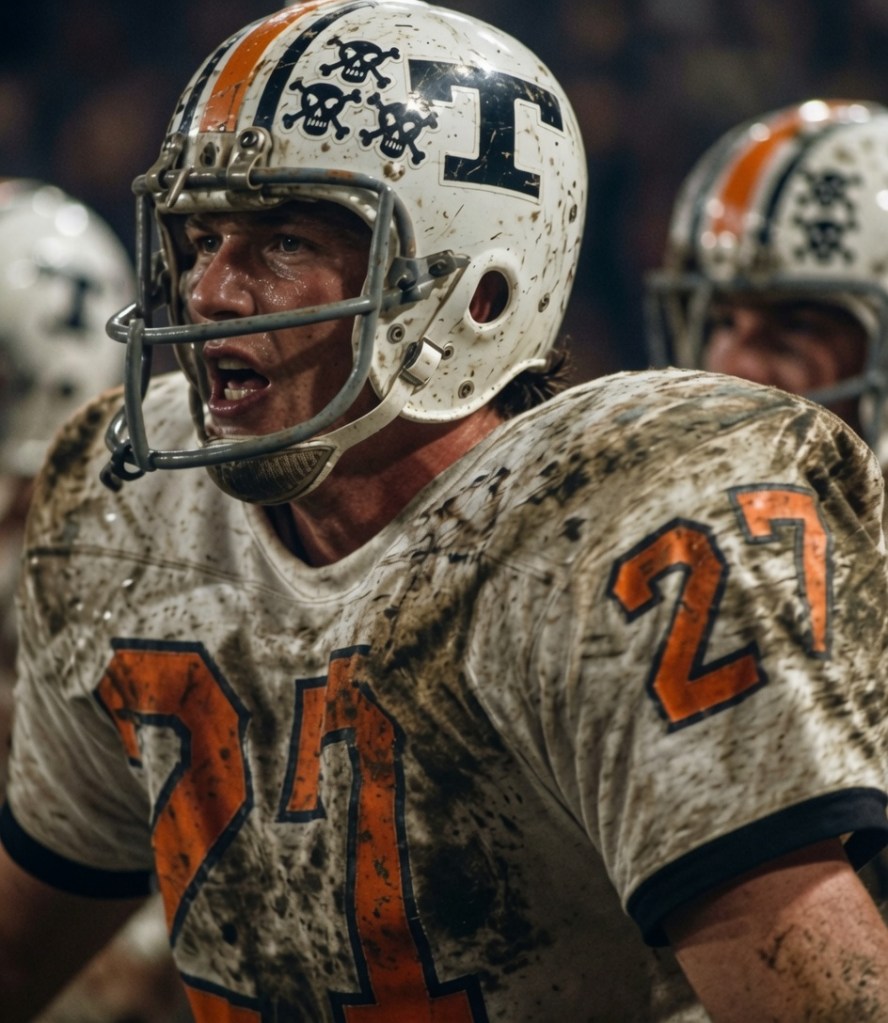
Magulick also instituted sticker awards that have since become popular and can be seen famously in the college ranks on helmets like Michigan and Ohio State.
Things were going to change when Magulick left. Shonewolf returned in 1975, and brought back numbers on helmets as well as black pants.
But more importantly, Tyrone joined a new conference, an alignment of schools from Blair, Huntingdon, and Centre Counties that remains, in essence, to this day. Needing to get away from big schools like Lock Haven and State College, while also desiring a conference where a champion could be determined by head-to-head play instead of the convoluted Saylor System of points and power points, the Golden Eagles joined the Big 8 in 1975. It had initially formed in 1973, but Tyrone took a wait-and-see approach as it struggled to gain footing.
The Eagles opted in two years later, and the conference lasted until 2003. It morphed into the Mountain Athletic Conference, and then the Mountain League, and today it is, for all intents and purposes, the Laurel highlands Conference East Division.
The classic 60s look inherited and modified by Shonewolf and Magulick had plenty of staying power, and it would take a while before Tyrone’s uniforms were seriously reimagined. That would take almost another decade, but when it happened, under a coach with as much staying power as the old uniforms themselves, the Eagles would be outfitted in gear that broke the mold and set them off into the 80s in style.