
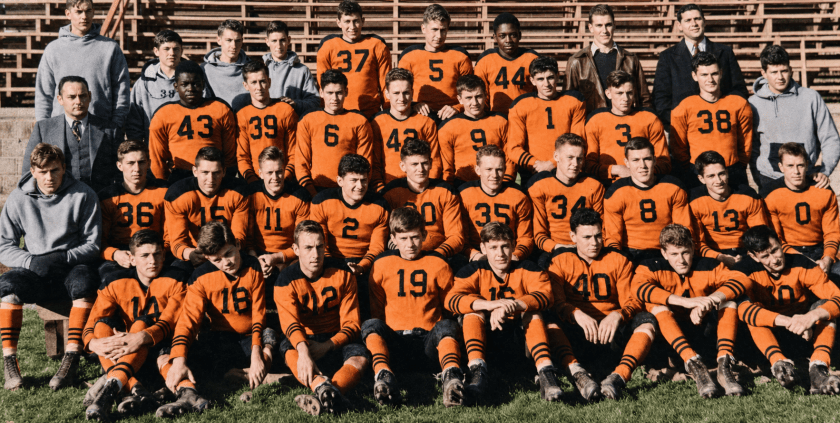
No. 5: Early 40s mystique
(This article draws heavily from a much larger dive into the Steve Jacobs era teams of the 1940s found in the book The Tyrone Football Story: A Team, A Community, and 100 Years of Defying the Odds, published in 2021. It is available on Amazon by clicking here.)
John Keats once wrote a poem about an old Grecian vase.
For a young person reading it today, it’s kind of a crazy subject to spend time thinking about, let alone describing it in verse, and who knows? Maybe school kids in the 1800s, when Keats wrote it, felt the same.
But there’s more going on than flowery depictions of maidens and fair youths underneath trees. In its entirety, it’s a reflection on moments caught in time, frozen so they can never change.
In “Ode on a Grecian Urn,” Keats explains that while everything in the world is transient, art is eternal, and there’s a beauty to that. That handsome young man on the vase is never going to actually kiss the maiden, but he’s never going to stop loving her either, and she will never grow old and lose her beauty.
That’s the magic of art, and it’s the magic of old photos, as well. Susan Sontag was more pessimistic 150 years later when she wrote that “All photographs are memento mori.” Unlike Keats, who saw the magic of capturing moments in time through images, she saw photos as reminders of our mortality because by simply taking a photo one is marking a time that will never be the same again. “To take a photograph is to participate in another person’s (or thing’s) mortality, vulnerability, mutability.”
Those characteristics make the remaining photos of Tyrone’s football team in 1940 both sad and special.
This was an era when Tyrone and the rest of the United States were beginning to emerge from the Great Depression. Full recovery wouldn’t come until the country left WWII as the world’s super power, both economically and militarily, but by 1940, optimism was on the rise. Pearl Harbor was more than a year away, and while there was certainly anxiety over exactly where the US would fit in the growing conflict in Europe, for a high school boy there was still time to do those things boys did, and in Tyrone that meant playing football.
So when you look at photos of Tyrone’s team in 1940, you see a lot of healthy young men eager to play the game. And in Pennsylvania in 1940, no one played it better than the Golden Eagles.
Because the Keystone state is widely regarded as one of the country’s major hotbeds of high school football, it’s hard to believe that it took as long as it did to create a proper state playoff system. District 6 didn’t even play for championships until 1985, and a statewide system for determining champions wouldn’t come until 1988.
In 1940, the path to a state championship was much more convoluted than today. For Tyrone, it began with winning a league called the Western Conference. This was a grouping of 37 schools that looked a lot like current day Districts 5 and 6. With that many teams involved, head-to-head competition wasn’t always the determining factor in crowning a champion. Instead, the league used a weighted points system to establish a winner.
The same procedure was used in the Eastern Conference, which was comprised of 33 schools from what would now generally be Districts 2, 4, and 11.
In 1940, Tyrone was in a race with Huntingdon for the Western Conference title. The teams were fierce rivals, and within just a few years they would cancel their series altogether when Tyrone accused the Bearcats of foul play (which is part of the reason Bellwood-Antis grew into the Eagles’ top rival).
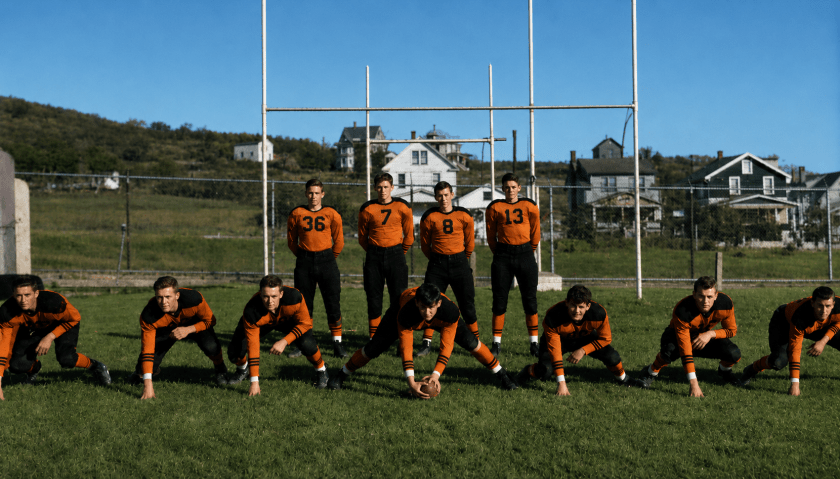
The Eagles were on another level that year, averaging 33 points per game during the regular season while allowing fewer than 3, and their uniforms were just as sharp. They wore orange jerseys trimmed with black on the shoulders and black pants highlighted with orange stripes. On top, their Zuppke model leather helmets were a matching orange and black.
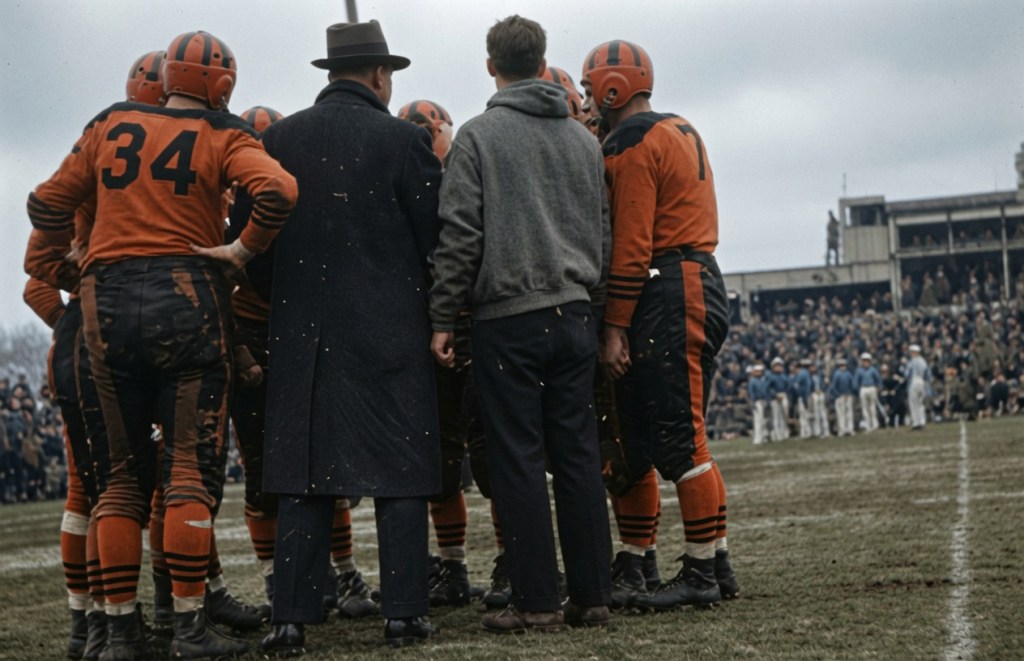
It was quite the look when the teams played in Huntingdon in the final game of the regular season on Thanksgiving Day. When the Eagles won 13-0, it began a wild celebration that included tearing down one of the Bearcats’ new wooden goal posts and brining it back to the borough to burn in a celebratory bonfire at the corner of 10th Street and Pennsylvania Avenue. The conflagration nearly burned down the wires regulating stop lights at the intersection, and before the night was done several arrests were made, but at the end of it all one fact remained: Tyrone would be playing the next week in the Central Pennsylvania High School Football League championship which was, in the absence of a PIAA playoff, a state championship game.
The Eagles’ opponent was Shenandoah, a Coal Region school that had actually finished second in the Eastern Conference standings. To their fortune, Scranton Tech, which had finished the season unbeaten, had a ban on post-season games, allowing the Blue Devils to accept the berth.
The game took place in Shenandoah on December 7, one year before the bombing of Pearl Harbor. By then, one former Golden Eagle, Tete Snyder, who graduated in 1938, was already stationed at the Hawaiian base, and in the days before the game he sent a letter back home, wondering just how much further the US would become entrenched in the foreign war.
“I guess the draft will get quite a few of the boys, but they shouldn’t worry, as this is great fun and good experience,” he wrote.
Moments frozen in time.
The game itself was nothing special, largely because the weather made it nearly unplayable. A week of rain, sleet, and snow had frozen the playing surface at Shenandoah, and on the day of the game groundskeepers attempted to soften the surface by burning swaths of it, but all that really did was create patches of thick mud. Conditions like those favored the weaker, but much heavier, Blue Devils.
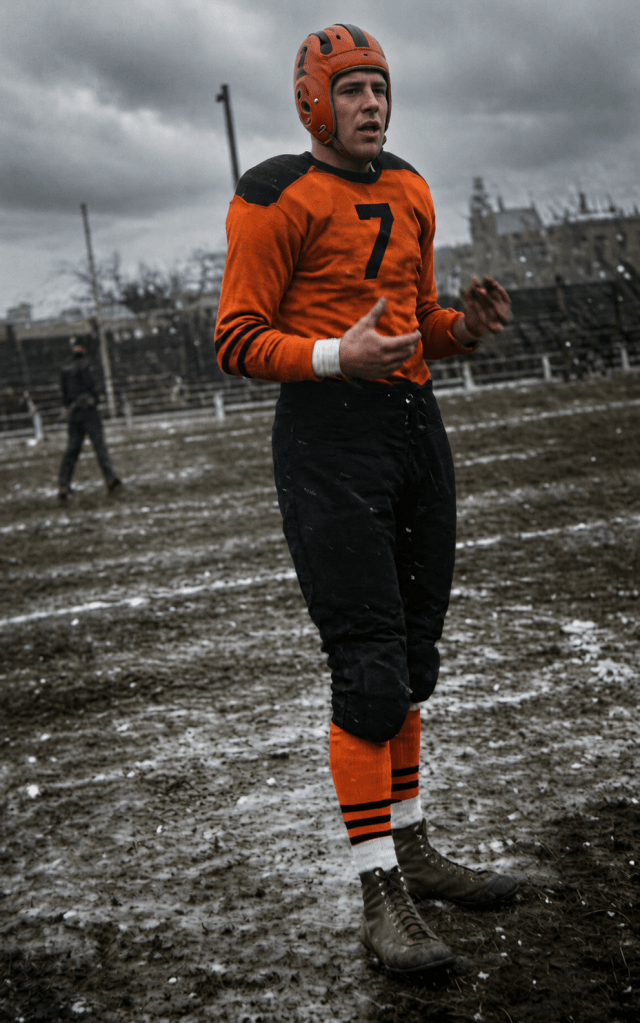
The razzle-dazzle style of play favored by Coach Steve Jacobs was rendered useless, as was the straight-on power game of Shenandoah. Both teams had chances, but in the end the game concluded in a 0-0 tie. They were crowned co-champions, and Tyrone shared a mythical state championship.
It was the last time the CPHSFL would play a head-to-head championship between the Eastern and Western Conferences, so PA wouldn’t see another champion crowned on the field for almost 50 years.
It was also the last time Tyrone’s players were able to be boys. Most of them would go on to serve in WWII, and three would pay the ultimate price. Stanley Catich, an end who shined in the CPHSFL championship game after being forced into major action when Bob Bickel had been declared ineligible for exceeding the age limit, was killed while serving in France on June 30, 1944.
The following February, Terrance Weston, a junior lineman who started on the championship team in 1940, was killed in Luxemburg on February 18. One month later, Bickel died on March 21 while fighting in Germany.
Jacobs himself would eventually leave Tyrone and the program he led to the ultimate heights in order to contribute to the war effort. Following the 1942 season, when the Eagles finished 11-0-1 and captured another Western Conference championship, he enlisted in the Navy and was gone for three full seasons in the prime of his career. He would return in 1946.
Following the CPHSFL championship game, the Eagles were paraded back into town and celebrated for weeks at ceremonies and banquets. And like other championship teams that followed, the Golden Eagles of 1940 were reunited hailed many times in the years after their record-setting season. In 1998, they were even joined with their opponents from Shenandoah when Tyrone played a game against Shenandoah Valley.
Unlike those other teams, the group from 1940 was never again reunited in its entirety. There would always be three pieces missing.
That fact alone shades those old photographs in contrasting tones. By one measure, they capture images of innocence and youth that can’t fade. The kids in those pictures haven’t accomplished anything yet, but they will always be young, always smiling, always hopeful of winning the big one.
But there’s a somber tone, as well. The players are frozen in a moment that will never live again, and that was true from the instant the pictures were taken, but for Bob Bickel (15), Terrance Weston (11) and Stanley Catich (38), it’s deeper. They had no inkling in the fall of 1940 of the horrors of 1944 and 1945. All they knew was that instant and that season, and it was fleeting.
The pictures themselves were proof of their mortality.

